

On August 4–9, 2026, Rating Group conducted a nationwide survey on identity, patriotism, historical issues, and political attitudes.
National Identity of Ukrainians
An overwhelming majority of respondents (90%) said that being a citizen of Ukraine is personally important to them.
According to respondents, the most important factor for considering oneself Ukrainian is self-identification (95%).
- Other important characteristics include a sense of responsibility for the situation in the country (92%), respect for laws and the political system (89%), and being part of the Ukrainian cultural space (88%).
- Speaking Ukrainian was mentioned by 80%, long-term residence in Ukraine by 74%, belonging to the Ukrainian nationality by 69%, and being born in Ukraine by 67%.
- The least important characteristic was belonging to the Christian religion (48%).
Civic, Local, and European Identity
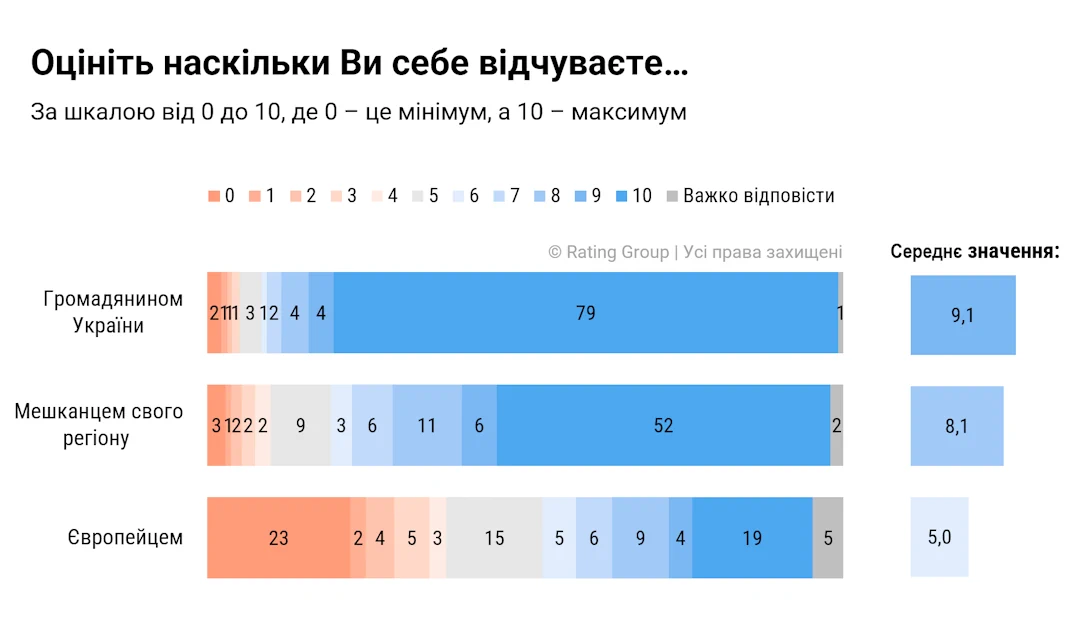
Respondents identify most strongly as citizens of Ukraine, with an average score of 9.1 out of 10.
- Local identity is somewhat less pronounced at 8.1, while European identity stands at 5.0.
- Civic identity remains consistently high, although it has declined from its peak of 9.7 in April 2022.
- Local identity fell from 9.4 points in 2022 and has since stabilized at 8.1.
- European identity also declined from 6.4 points in April 2022 to 5.0, but still remains above the pre-war level of 3.6 recorded in August 2021.
Perceptions of Patriotism
- Respondents most often identified respect for the law (39%), defending democracy, human rights, and freedoms (36%), and preserving Ukrainian culture (33%) as signs of patriotism, followed by using the Ukrainian language and serving in the military (24% each).
- Other important expressions of patriotism included volunteering and helping people (19%), honoring Ukrainian history (18%), active participation in public life (17%), and living in Ukraine (15%).
- Less frequently mentioned were paying taxes (13%), supporting Ukrainian producers (10%), caring for the environment and nature (9%), and representing Ukraine’s interests abroad (5%).
Perceptions of Historical Figures
We asked respondents to name the three greatest Ukrainians of all time in an open-ended question.
- More than 60% of respondents named Taras Shevchenko.
- Lesia Ukrainka was named by 28.4%, Bohdan Khmelnytskyi by 15.9%, Stepan Bandera by 11%, Volodymyr Zelenskyy by 10.4%, Ivan Mazepa by 9.9%, Mykhailo Hrushevskyi by 9.8%, Hryhorii Skovoroda by 9.1%, and Viacheslav Chornovil by 8.9%.
- Other prominent Ukrainians mentioned included Valerii Zaluzhnyi – 4%, Vasyl Stus – 3.9%, Lina Kostenko – 2.8%, Oleksandr Usyk – 2.7%, Petro Poroshenko – 2.5%, Yaroslav the Wise – 2.4%, Serhii Korolov – 2.3%, Volodymyr the Great – 2.1%, and Roman Shukhevych – 2%.
- Fewer than 2% named Andrii Kuzmenko (Skryabin), Andriy Shevchenko, Pavlo Skoropadskyi, Ivan Kotliarevskyi, Symon Petliura, Petro Konashevych-Sahaidachnyi, Pylyp Orlyk, or Ivan Sirko. Around 1% named Bohdan Stupka, Igor Sikorsky, and Viktor Yushchenko.
In another set of questions, we provided respondents with a list of selected historical figures and asked them to evaluate them.
- Among the figures listed, respondents expressed the most positive attitudes toward Bohdan Khmelnytskyi (90%), Mykhailo Hrushevskyi (84%), Ivan Mazepa (82%), and Stepan Bandera (74%).
- Attitudes were moderately positive toward Pavlo Skoropadskyi (63%), Symon Petliura (59%), and Roman Shukhevych (56%).
- Perceptions of Nestor Makhno were rather mixed: 45% viewed him positively and 22% negatively, the highest negative rating among all the figures included.
- Attitudes toward Volodymyr Vynnychenko (40%), Yevhen Konovalets (39%), and Andrii Melnyk (25%) were predominantly positive. At the same time, respondents were least familiar with these historical figures, with 44% to 65% saying, “I do not know this person.”
- Attitudes toward Symon Petliura and Ivan Mazepa improved noticeably in 2026 compared with 2022, rising from 49% to 59% and from 74% to 82%, respectively. Attitudes toward Stepan Bandera and Mykhailo Hrushevskyi remained consistently high at 74% and 84%, respectively.
Perceptions of Soldiers from Different Historical Periods
- An overwhelming majority of respondents have a positive attitude toward soldiers of the modern Ukrainian Armed Forces (98%), Soviet Army soldiers who fought against fascism (87%), and soldiers of the Ukrainian Insurgent Army (UPA) (74%).
- Attitudes toward soldiers of the Ukrainian People’s Republic (UPR) and the Western Ukrainian People’s Republic (ZUNR) are predominantly positive (64%), although this category also has the highest share of respondents unable to answer the question (26%).
- A majority of respondents, 82%, support recognizing the OUN-UPA as participants in the struggle for Ukraine’s state independence, while 10% oppose this and 8% are undecided.
- Support for recognizing the OUN-UPA as fighters for Ukraine’s independence remains at 82% in 2026, essentially matching the 2022 figure of 81% and showing a substantial increase compared with 2019, when support stood at 45%.
Historical Issues and Historical Legacy
- 45% of respondents support banning only those Russian and Soviet cultural products that contain direct anti-Ukrainian propaganda.
- 33% support their complete removal and prohibition from Ukraine’s public space. Another 20% believe people should have the right to decide for themselves which cultural products they consume.
- 50% of respondents described the Soviet Union as a totalitarian regime that carried out repression and destroyed Ukrainian identity, while 45% noted both positive and negative aspects. Only 4% believe that the Soviet Union brought Ukraine development, industry, and social guarantees.
- 60% of respondents view the Revolution of Dignity as a struggle by citizens for their rights, freedom, and European choice, while 25% see it as an ambiguous event whose consequences cannot yet be fully assessed, and 13% describe it as a coup d’état that led to territorial losses and war.
- 43% of respondents said that questions of history and the future are currently not a priority because the immediate task is to survive and preserve the state. Another 38% are focused on building the future and giving it priority over a controversial past, while 16% emphasized the importance of restoring historical memory.
- 65% of respondents expressed support for establishing a Ukrainian National Pantheon, while 8% opposed creating such a memorial complex and 25% had not heard about the initiative.
- 64% believe that the main purpose of the Ukrainian National Pantheon should be to combine the commemoration of historical figures with honoring contemporary heroes.
- 16% see its main purpose as the burial and commemoration of heroes of the current Russo-Ukrainian war, 3% as honoring and reburying outstanding historical figures of the past, while 13% believe that such a pantheon is not needed at all.
Views on the Overall Situation and Ukraine’s Future
- 43% of respondents believe that developments in Ukraine are moving in the wrong direction, while 39% say the country is moving in the right direction, and 18% are undecided.
- As of August 2026, respondents identified victory in the war as the main factor necessary to preserve Ukraine’s independence (54%).
- Compared with July 2025, the perceived importance of eliminating corruption increased from 35% to 40%, while the importance of social unity rose from 30% to 37%. Economic development was named by 15%, strengthening defense capabilities by 14%, fairness of government by 11%, accession to NATO and the EU by 4% each, and the development of Ukrainian culture and international support by 3–4% of respondents.
- 38% of respondents envision Ukraine’s post-war future as a self-sufficient “fortress state” relying solely on its own strength and remaining outside alliances. Another 29% see Ukraine as a member of the EU and NATO and as a European democracy, 21% as the leader of a regional alliance with neighboring countries such as Poland, Lithuania, and others, 7% as a neutral non-aligned state, and 1% as a member of a new alliance with Belarus and a “democratized” Russia.
- 51% of respondents believe that the current war is, for Ukraine, a war of liberation for the very existence and independence of the state. Another 35% describe it as a geopolitical conflict between major powers in which Ukraine is being held hostage, while 11% view it as an exhausting and self-destructive war in which the losses outweigh the gains.
Rating Group is one of Ukraine’s largest research institutions and has been operating since 2008. The company is registered in Ukraine and has extensive experience conducting sociological surveys both in Ukraine and abroad. The group includes the Rating Sociological Group, the Rating Lab research laboratory, the Rating Online platform, and the Rating CATI Center.
Methodology
- Fieldwork dates: August 4–9, 2026
- Survey method: CATI (Computer-Assisted Telephone Interviewing) – telephone interviews conducted with computer assistance
- Sample size: 2,000 respondents
- Sampling format: random sample of mobile phone numbers, covering the population of Ukraine aged 18 and older in all regions except the temporarily occupied territories and areas where Ukrainian mobile communications were unavailable at the time of the survey. The results were weighted using current data from the State Statistics Service of Ukraine.
- Representativeness: the sample is representative by age, sex, and type of settlement, with a margin of error not exceeding 2.2% at a confidence level of 0.95.
Note: In some charts, the percentages may not add up arithmetically to exactly 100% due to rounding, including the rounding of small values.
Source: www.ratinggroup.ua


