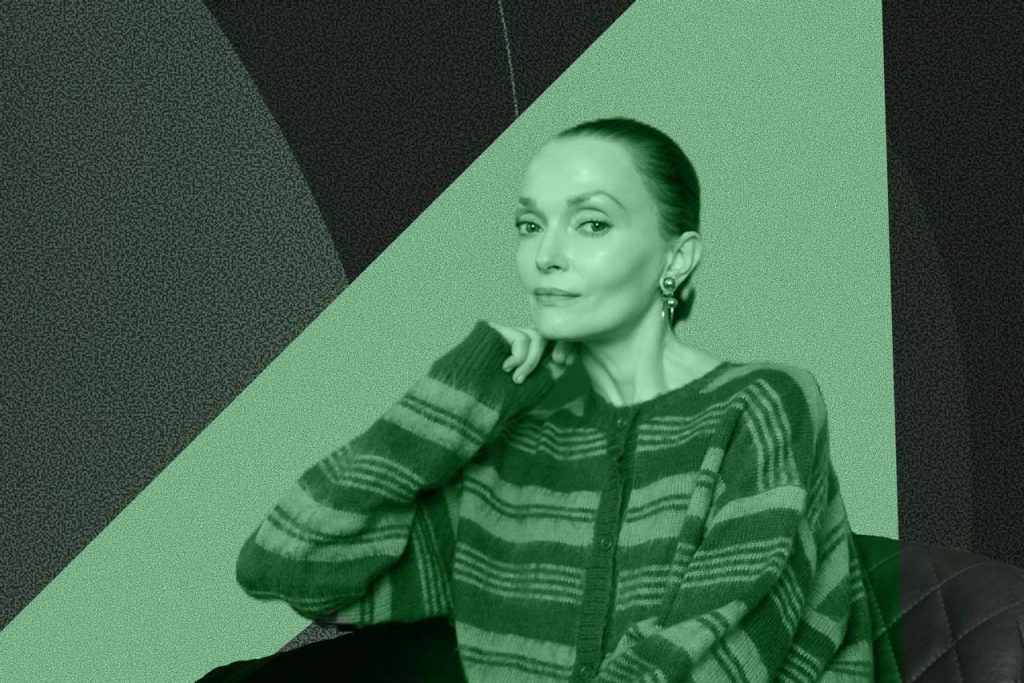

Yevhen HLIBOVYTSKYI is an expert in long-term strategies, a member of the Nestor Group of Experts and the Dnipro-based DYC (Develop Your City) group, a lecturer at the Kyiv-Mohyla Business School, and the founder of the strategic consulting and marketing company pro.mova.
This lecture was delivered at the conference “Resilience: UA” on 24 April 2023 at the Ukrainian Catholic University.
“A Vision of Ukraine’s Future as an Inspiration for Our Resilience.” That is the topic of our conversation, and I will try to answer it quite literally. It seems to me that we first need to make several clarifications. For example, we need to understand how a vision differs from a fantasy and how a vision differs from a dream. A vision is not simply our attempt to arrive at some different reality. It is an effort constrained by a sound understanding of context. It is embedded in the present context; it is conscious of threats, conscious of opportunities, conscious of available resources, and conscious of the changes that are taking place.
This is a dynamic understanding. In that sense, today’s vision and tomorrow’s vision may differ while remaining parts of the same continuous discourse. To me, the way strategic planning is practiced today is very illustrative in this regard. I currently lead the strategy project for the city of Ivano-Frankivsk, and people constantly asked me what this strategic document would look like. My response was that there would most likely be a document, but strategy is not about a document—it is about a way of making decisions. If we make decisions with longer planning horizons in mind, with a better understanding of contexts, and with a better understanding of how uncertainty can be transformed into certainty, then it ultimately makes little difference whether or not such a document has been formally written. We will still arrive at higher-quality decisions. And strategic planning is precisely about improving the quality of our decisions.
That is why the key question concerning our vision is how we deal with certainty. Here I would like to go all the way back to the fall of the Berlin Wall, because I believe it represents a crucial point for understanding how we build our relationship with certainty. It allows us to reflect on the transformation of those territories that crossed the Berlin Wall—a wall that stood in the middle of Berlin in 1989 but today, in a sense, has reappeared along the front line between Russia and Ukraine.
When East Germany integrated into West Germany, East Germans moved from a bad certainty to a good certainty. They were entering a reality they could already understand and imagine because they had long had access to West German television, West German culture, and much more.
For the countries of the Visegrád Group, the transition was likewise a movement from an undesirable certainty toward an imagined certainty. That certainty was created by their projection of the historical path that had been interrupted by communism. They imagined that had communism never existed, they would now be roughly where their neighbors—for example, Austria—had arrived. Thus, they too were moving from one form of certainty to another.
Ukraine’s problem was different. Only Galicia—and perhaps a few isolated cultural enclaves elsewhere—was moving from one certainty to another. For the overwhelming majority of Ukrainians, the transformation of the early 1990s was not a movement toward something but rather a movement away from something. Here it is critically important to understand how Ukraine proclaimed its independence. Our Declaration of Independence was not the result of a national movement gradually accumulating enough critical mass to assume political agency and take responsibility for decision-making. Let us remember that on the day independence was proclaimed, the People’s Council in the Verkhovna Rada held less than one-third of the seats. The Communists still constituted the majority. Moreover, on the day of the referendum, when approximately 90 percent of Ukrainians voted in favor of independence, those same 90 percent—by an overwhelming majority—also elected Leonid Kravchuk as President. The social contract that existed in Ukraine at that moment therefore did not consist in abandoning the Soviet social contract—under which the state provided resources in exchange for citizens surrendering their agency. Rather, it consisted in preserving that Soviet social contract. In other words, it was an attempt to preserve a social contract based on the absence of agency: you relinquished your capacity to act as a political subject, and in return the state provided social benefits. The August Coup, however, shattered that arrangement. The Coup effectively declared: “No. You surrender your agency—and then we will kill you anyway.” That became a sufficiently powerful reason for society to grant its elites a mandate for virtually any changes—precisely so that, in essence, nothing fundamental would change. Suddenly, the idea of Independence filled the vacuum left by the absence of any viable alternatives. That is one of the reasons why Ukraine took so long to move from the moment it acquired the shell of statehood in 1991 to the point in 2014 when a critical mass of citizens possessing genuine agency emerged—from below and across different layers of society—people capable of assuming responsibility themselves or compelling other actors to behave differently and modify their conduct.
What happened afterward was, above all, the loss of fantasy—or perhaps more accurately, the loss of illusions. And there were many such illusions, because all of us—even people like me—were products of that system. One of my earliest childhood memories is Leonid Brezhnev’s funeral. From the perspective of today’s students at the Ukrainian Catholic University, this must sound almost prehistoric, something comparable to memories of dinosaurs.
Yet I still consider myself a relatively young person, despite the fact that I was shaped by the Soviet Union. That formation left behind a long trail of assumptions, many of which amounted to oversimplified ideas about institutions and the way they function within society. For example, in the 1990s our understanding of democracy was essentially an understanding of the dictatorship of the majority. Our understanding of the market economy was an understanding of the right of the wealthy—the belief that what matters is whoever possesses greater quantitative power. We did not yet understand democracy as a balanced system, or democracy as a system in which the minority influences the pace at which the majority implements change. Nor did we understand the role of minority actors within a market economy. Nor did we understand the importance of minorities in general: people with disabilities and without disabilities; those who are different because of ethnicity, behavior, or innate characteristics; in short, every kind of minority. Ultimately, each of us, depending on the criteria being applied, will at some point find ourselves in the unprivileged position of belonging to a minority. And at that moment, we too begin to rely on the system—a more humane system of norms—to protect us. It was here that our imagined reality collided with reality itself.
One of the accelerations of our present era, which Professor Yaroslav Hrytsak often speaks about when explaining how the war has catalyzed social processes, is that Ukrainians have never before been as deeply integrated into Europe as they are today. Never before have they had so much personal contact and personal experience. Suddenly, however, it becomes apparent that our dominant perceptions of the West resemble what many businesspeople already discovered during the 1990s and early 2000s. At that time, they enthusiastically tried to build Western business models by copying Western catalogues, believing that those catalogues accurately reflected reality. In truth, advertising catalogues reflected only an advertising image. Likewise, we suddenly find ourselves in a situation where, in our own eyes, Ukrainians often behave more “European” than certain Western actors, who may act more opportunistically or be more inclined toward zero-sum games. In other words, our idealized image of the West suddenly proves incapable of accommodating what is often called Western “realism.” This becomes the moment when we begin to understand that the real issue lies in differences between models—and that these differences are significant. Yet if we look beyond the models themselves, we discover something important. People are simply people. Across the entire world, some will behave better, others worse—but fundamentally they will behave as human beings. This means that we will encounter evil in different places. We will also encounter kindness and hostility in different places. The particular definition of evil may vary. The specific forms of what we encounter may differ. But those differences are determined precisely by the model within which a society operates.
This naturally raises another question: How should we look at ourselves, and how should we imagine ourselves in the future? The simplest method—indeed the one employed in most basic strategic planning—is to take the previous period and project it into the future. In Ukraine’s case, however, this is perhaps the least reliable thing we could possibly do. Projecting the past onto the future simply does not work here. As Roman Kechur has aptly observed, we are fleeing from our past. We are fleeing from the recurring trauma that continually catches up with us, and we dream of a future in which the next generation will not have to solve the same problems that burdened the previous one. This means that Ukrainian society’s readiness for change—and the radical extent of that readiness—is far greater than one would normally measure. I would even say that it exceeds the scales typically used to measure social change in the average society of the European Union. Put differently, the degree of change that Ukrainian society is prepared to tolerate—or even actively seeks—extends well beyond what societies such as France or Germany would ordinarily regard as conceivable. As a consequence, their forecasts and assessments of Ukraine’s capacity will continually collide with the limitations of their own measuring scales. They will continue to revolve around predictions such as the famous “Kyiv will fall within ninety-six hours,” while Ukraine itself proceeds according to an entirely different internal logic. This will continue until our integration becomes deep enough that we genuinely begin to understand one another, and until our respective frameworks for measuring reality become compatible. Звичайно. Продовжую з точним академічним перекладом, без скорочень, максимально зберігаючи структуру абзаців і авторський стиль.
Now the question is: Where are we, and where can we find ourselves? The direction shared, I believe, by the overwhelming majority of people in this audience is that Ukraine is part of the West, and that we should belong to the two principal Western clubs: NATO and the European Union. This idea has probably dominated since the late 1990s, or perhaps even earlier. As far as NATO is concerned, it probably became dominant already during the final years of the Soviet Union. As for the European Union, it gained prominence as the European Union increasingly demonstrated itself to be a successful community of prosperous countries.
The problem, however, is that by the time membership in these clubs becomes possible, we may find ourselves joining them not as a railway carriage that sheds part of its burden, but as a locomotive that takes on additional weight. This is a very important point with regard to NATO. The idea that, should isolationists prevail in the U.S. elections, the United States might withdraw from NATO would have seemed utterly absurd only a few years ago. Today, however, it has become a realistic possibility. This means that the global architecture of security alliances could be fundamentally redefined. A major geopolitical reshuffling could take place. Suddenly, from the perspective of Ukrainian leadership, what we actually need is not NATO membership as an end in itself. What we need is reliable security. At present, reliable security means NATO membership. But what if NATO ceases to be a viable alliance? How, then, should we guarantee our security? Does this mean that we should begin thinking about entirely different security arrangements? Or does it mean that we should follow the trend increasingly discussed by Western analysts—that in the emerging world order not only great powers but also middle powers become nuclear states in order to guarantee their own security? That is a good question.
The next question is: What exactly is our European Union? Is it a union of prosperity? Is it a union of quality of life? Is it a union of high standards and sound rules? Here we suddenly discover that these standards and rules are not necessarily good in every respect. Anyone who has encountered the paper-based nature of German bureaucracy—and that now includes several hundred thousand Ukrainians—has realized that some things can, in fact, be done better. Very well. We have our own dynamics in the relationship between paternalistic forces and the middle class. The Ukrainian middle class has managed to secure certain privileges, one of which is contactless interaction with the state. Such contactless interaction was never a priority for Western countries, because they do not perceive the state as something inherently threatening. We, on the other hand, tend to regard the state as a constant potential source of harm. Consequently, the less direct contact we have with it, the more comfortable we feel.
Then come other issues: the quality of public services; the opportunities available to those who wish to configure the system according to their own needs. Suddenly, we discover that the European Union has no ready-made answers to many of these questions. Within the Nestor Group, some of our discussions revolved around whether, by integrating into the European Union, Ukraine is choosing one particular path of European civilization while simultaneously abandoning other European paths. For example, another path of European civilization is the North American one. It too originates in Europe, yet it embodies an entirely different set of assumptions regarding individualism, individual rights, the meaning of freedom, the place of private initiative, and the role of the state. Moreover, it offers its own spectrum of models—from the Mediterranean-style variant represented, conditionally speaking, by Mexico, to the more left-leaning model represented by Canada.
This inevitably raises another question: Is European integration truly a panacea? As we mature, we suddenly begin telling ourselves: “Wait a moment. What we actually need is not European integration for its own sake. What we need is a certain quality of life. Perhaps European integration is the way to achieve it. Or perhaps it can be achieved in some entirely different manner.” This is precisely the moment when visionaries become indispensable. We cannot turn back toward the past. We no longer possess it. It has been burned away. There is no path leading backward. Sooner or later, we will witness conservative political parties in Ukraine campaigning either by appealing to such a distant past that no one can actually remember it, or by invoking some version of a past that never truly existed. Alternatively, we may find ourselves in a vacuum of ideas—a vacuum that will compel us to answer the question of how we envision ourselves under circumstances in which virtually every significant component of our reality has changed. Above all, this concerns the human component. Ukraine ranks approximately 150th in various international comparisons of institutions—I am simplifying considerably here. It ranks approximately 100th in terms of infrastructure, out of around two hundred countries. Yet when it comes to human capital, Ukraine ranks approximately 50th. At that point, there is no longer any question about what will serve as the locomotive and what will become the railway carriages. It is human capital that will pull Ukraine forward.
We have suffered a blow that has struck this human capital with tremendous force. Above all, this has happened in quantitative terms. In fact, Ukraine was already facing a severe demographic crisis before the war. Now we find ourselves in a truly catastrophic demographic situation—one that has no solution without migration. Yet a migration-based solution is culturally complex. It means that we must formulate, in an entirely different way, our willingness to integrate others into our society and to explain ourselves to them. So far, however, we have not been particularly successful in this regard. If we look at Ukraine’s ability to persuade the Global South to empathize with our anti-colonial history, we can clearly see that, at present, we are losing by a landslide. We have failed to shift the mainstream opinion in our favor in a single country of the Global South. We have not succeeded. Simple propaganda and falsehood continue to prevail over the message Ukraine is trying to convey.
It naturally follows that, within these circumstances, we must imagine how we can formulate our own vision of a desirable future. And this vision must transcend—not only our own boundaries, and this point is important—but also the boundaries of what the so-called “established institutions” are prepared to discuss or even imagine. One interesting attempt in this direction is the Manifesto for Sustainable Peace. It is an effort on Ukraine’s part to formulate what at least this region should look like after the war has ended. The document received a very cold reception. I would even say it was largely ignored within Western analytical circles. At best, it was acknowledged in passing. In most cases, however, it was simply overlooked. In fact, this represents yet another stage in our maturation. We are gradually teaching others that voices coming from Ukraine deserve to be taken seriously. This leads us to several elements that every genuine vision must contain.
First, it must be thoroughly developed. In other words, we must be capable of speaking the languages and meeting the standards employed by the most advanced part of humanity.
Second, it must be well adapted to the circumstances of our environment. This means possessing the tools necessary for accurately reading reality and understanding contexts. This, too, is another sign of maturity that has gradually come to us.
Third, we must be sufficiently creative to move beyond the boundaries of what already exists and to formulate our future in categories that have never existed before.
At this point we arrive at what appears to be an obvious fourth element and a far less obvious fifth one.
The fourth element is that we must be able to connect all these components together. In other words, our vision must not become merely a fantasy.
But there is also a fifth element. We must learn how to package this vision and communicate it to other important stakeholders in such a way that they are able to understand what we are talking about. This is precisely the point at which we are still absent. We are not yet at a stage where our voice sounds persuasive from a German perspective, or a French one, or—in many cases—even a Polish one. This applies particularly when we speak about the political or social mainstream.
We must also learn to understand that a vision must always be addressed to someone. And if it is addressed to someone, it must take its audience into account. It must consider those who are expected to respond to that vision in one way or another.
This homework has not been completed not only with regard to our Western stakeholders. It also remains unfinished with regard to our Eastern ones. I mean those people whom we should be reaching with requests for support and messages of hope: the Ichkerians, parts of Russian society, the Bashkirs, the Tatars, and many others. We are not there yet. If our voice is heard at all, it is perceived only in a highly transformed and heavily distorted form.
A vision, like a strategy, is a continuous process. At the beginning it may resemble a project, but afterward it becomes an ongoing process in which we constantly take new factors into account, reassess their significance, and slightly adjust the direction of our movement. It is a process that requires our radar to remain permanently active. It is a process that demands careful listening to our environment. It is a process that depends upon meaningful interaction with others. And it is a process that cannot be carried out while remaining closed in upon ourselves.
Source: Zbruc