Молодь за майбутнє України

Materials

Hierarchy of Skills and Competencies: The Church Between Survival and Adaptation

We live in a world in which external limitations on the individual are becoming fewer and fewer. This concerns not only freedom of movement or access to information. The very architecture of human life is changing: what only a few centuries ago was determined by one’s place of birth, social status, territory, access to knowledge, profession, or tradition today depends to a much greater extent on personal choice.
Read more »

Distrust by Default, Trust by Merit?

“If it has to be explained, then it does not need to be explained” – one of the most popular expressions defining the boundary between “our own” and “outsiders” in our society. Immediate affinity and a minimum of radical otherness are critical prerequisites for productive interaction.

Read more »

How Can Ukrainian Orthodoxy Be United?

The authors of the article proceed from the thesis voiced by President Zelenskyy upon the adoption of Law of Ukraine No. 3894-IX “On the Protection of the Constitutional Order in the Sphere of Activities of Religious Organizations” (referred to as the law on spiritual independence): an independent state must also be spiritually independent.

Read more »

What Rules Does Ukrainian Society Live By Today?

Million-scale donations for the needs of the military, often without demands for formal reporting, combined with the desire to pay as little tax as possible or not to pay taxes at all. A willingness to share one’s last possessions in order to help even not particularly close acquaintances whose homes have been destroyed, combined with corrupt schemes of an audacity unheard of even in a country that is not at war.

Read more »

What Rules Govern Ukrainian Society Today?

Millions in donations for the needs of the military, often without demands for formal reporting, alongside the desire to pay as little tax as possible or not to pay taxes at all. A willingness to share one’s last possessions to help even not-so-close acquaintances whose homes have been destroyed, alongside corrupt schemes of an audacity unheard of even in a country that is not at war.

Read more »

Where Is Our Vision of Victory and Life After It?

To prevail in the war and win the future, it is not enough to love one’s homeland. It is not enough to dislike Russians. It is not enough to speak Ukrainian, cultivate the cult of Stepan Bandera, or even be prepared to kill and die for Ukraine. We need to have in our imagination a vision of Ukraine – a dream of a Ukrainian “city upon a hill.”

Read more »

The Triangle of Balance

Whereas previously there was a strict Byzantine binary of “Church – state,” now there is a more intriguing triangle of “Church – society – state.” As with any transition from 2D to 3D, the Church-political picture has become more complex, but it now corresponds more closely to the rapidly evolving realities in Ukraine.

Read more »

What Is Collective Trauma and How Does It Arise?

For a considerable part of its history, Ukraine was under the oppression of neighboring states, subjected to attacks from all sides, censorship, and subjugation. For years, our history was rewritten and distorted, our traumas were silenced and denied, our intelligentsia was murdered, and attempts were made to destroy our language.

Read more »

On Dignity and the Social Contract

Ten or twenty years ago, Ukrainian intellectuals were actively – though entirely unsuccessfully – preoccupied with the search for a “national idea.” More recently, however, this theme has largely been displaced by discussions of the “social contract.”

Read more »

Polarisation and How to Prevent It

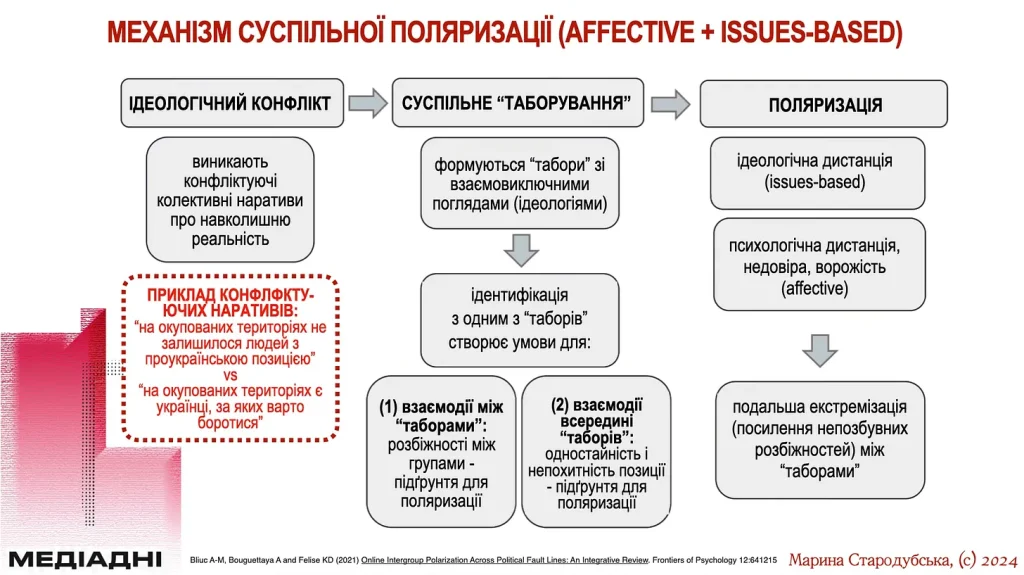
The full-scale war has now continued for more than half a year, and along many sections of the front it has turned into positional warfare. Fatigue, losses, trauma, uncertainty about the future, and a threat that shows no sign of disappearing are all making themselves felt.

Read more »
Scroll to Top