

Tetiana Derkach, religious journalist, Editor-in-Chief of “Religion in Ukraine”
We live in a world in which external limitations on the individual are becoming fewer and fewer. This concerns not only freedom of movement or access to information. The very architecture of human life is changing: what only a few centuries ago was determined by one’s place of birth, social status, territory, access to knowledge, profession, or tradition today depends to a much greater extent on personal choice. In the eyes of the Church, this may look like a sign of the “last times” – or like a window of new opportunities.
Three Revolutions That Changed the Church
The present differs radically from late antiquity, when the Church emerged, and from the early Middle Ages, when it accumulated the body of canon law, because of three anthropogenic breakthroughs that can simultaneously be called challenges for the Church: infrastructural, or logistical, informational, and technological booms. They correspond to such revolutionary stages as the invention of printing, the Industrial Revolution, and urbanisation, which are connected not only with changes in ways of life, but also with changes in ways of thinking, perceiving the world, and creating meaning.
The first was the printing revolution. The appearance of the printing press in the middle of the sixteenth century destroyed the monopoly of ecclesiastical and educated elites over the production and dissemination of texts and, most importantly, over their interpretation. What had previously existed in a limited number of manuscripts and had been accessible to a narrow circle of people began to be reproduced on a mass scale. Holy Scripture, theological texts, polemical literature, and later all kinds of other texts began to circulate far beyond traditional institutional channels. Printing became one of the factors in the crisis of ecclesiastical authority and sharpened the problem of defining the normative source of doctrine.
Mass access to Scripture intensified competition over meanings: it was no longer enough simply to transmit knowledge – it became necessary to learn how to form a person’s ability to comprehend faith independently. The Church was forced to reassess its entire meaning-making toolkit – education, preaching, and catechesis. In other words, printing turned out to be not so much a technological as a cognitive revolution.
A closer example for us of how printing affected the Russian Church is the following: when handwritten liturgical texts began to be systematically brought into conformity with a single printed standard, comparison with Greek books revealed discrepancies that later became one of the foundations of Patriarch Nikon’s reforms – with all the consequences familiar to us.
Today, after the emergence of the internet, this process has grown into an information boom multiplied by the development of artificial intelligence. Information has become practically unlimited in its availability, and the individual has found themselves in an environment of competing interpretations of reality. The Church can no longer proceed from the assumption that it controls the information field in which its believer lives. The information space is a space of meanings, not rituals. A ritual can simply be organised once and repeated endlessly, whereas meaning must be generated, formulated, adapted to the target audience, and competently communicated each time.
The industrialisation of production, also called the Industrial Revolution, at the end of the eighteenth century, accompanied by the transport revolution, created another challenge for the Church. The steam engine, mechanisation, and mass production gradually transferred to machines an increasing number of functions previously performed by human beings. Human beings themselves became extremely mobile. The contemporary technological boom continues this logic: more and more intellectual and physical work is being automated. This forces us to pose anew the question of what in the human being is truly human and what cannot simply be transferred to a technical system.
For the Church, this does not mean that it must now compete with technologies – I am convinced that artificial intelligence pastors will very quickly “go bankrupt” after the initial surge of curiosity. On the contrary: the importance is growing of what cannot simply be automated – responsibility, self-knowledge, moral choice, and the capacity for relationships. The more external human functions machines are able to perform, the greater the importance of a person’s capacity to be responsible for their own choices, understand themselves, build relationships, overcome internal conflicts, and correlate freedom with responsibility.
Thanks to the transport revolution, industrialisation produced yet another breakthrough – a demographic and structural one: urbanisation. If in 1800 only 3 percent of the world’s population lived in cities, by 2020, 56.2 percent of the population, more than 4 billion people, lived in urban areas. It is projected that by 2050 this figure will reach 68.6 percent of the world’s population. Urbanisation destroyed what the church parish had rested upon for almost one and a half millennia – automatic, inherited belonging. In a rural community, a person became a parishioner in the same way that they became a member of a family: without choice, under the social control of neighbours who noticed absence from Sunday worship, and within the rhythm of the agricultural calendar, where church feasts naturally coincided with the cycle of field work. The city broke this connection from several directions at once: a person lives among strangers who do not control their religious practice; their life cycle is shaped by a factory or office schedule rather than the liturgical year; and nearby, within half an hour’s journey by urban transport, there are dozens of other confessions, worldviews, and ways of life, making faith not a destiny but a choice.
The sociologist Peter Berger called this the “heretical imperative” – from the Greek word hairesis, which literally means “choice”: an urbanised person is condemned to choose their convictions every day, whereas a rural person simply inherited them. The Church, which for centuries could rely on the structural belonging of the parishioner, found itself in a situation in which belonging had to be earned and maintained under conditions of competition. And this requires not so much the mechanical transmission of dogma as specific skills for working with a living, independently thinking, and often sceptical human being.
At this point it would be very appropriate to recall the American anthropologist Margaret Mead, who distinguished three types of culture according to the nature of interaction between generations and the relationship between tradition and innovation: in postfigurative culture, the younger learn from the older; in cofigurative culture, older and younger generations learn from one another; in prefigurative culture, change occurs so rapidly that older generations are forced to learn from younger ones. The transition between these models occurs when the pace at which new experience appears exceeds the capacity of previous generations to transmit their own experience as a sufficient model for the future. This is precisely what gradually happened to European society: sixteenth-century printing undermined the Church’s monopoly over the transmission and interpretation of knowledge; the Scientific Revolution and the Enlightenment of the seventeenth and eighteenth centuries created alternative centres for the production of knowledge; and the Industrial Revolution, urbanisation, mass education, and new means of transport and communication in the nineteenth century radically accelerated social change. Society began to change faster than traditional institutions. In other words, a structural divergence in pace occurred: society moved from a world in which the experience of the previous generation was the main resource for adaptation to a world in which the experience of the previous generation became outdated increasingly quickly and, rather than helping adaptation, increasingly hindered it – and we will return to adaptation later. Thus society increasingly moved from a postfigurative model to a cofigurative one, and later to a prefigurative model, while the church system of transmitting experience largely remained postfigurative.
A revealing historical example of such a reaction can also be found in Victorian England, where, against the background of modernisation and secularisation, part of Anglicanism responded by giving greater attention to ancient liturgical forms and ecclesiastical identity. This was not simply a rejection of modernity, but it clearly demonstrates a reaction characteristic of institutions facing rapid environmental change: when new ways of responding have not yet been formed, the system reinforces what it already knows how to reproduce.
There is another reaction to radical environmental change – freezing. In psychology, adaptive freezing, or tonic immobility, is a defensive response to a situation in which active action is perceived as impossible or dangerous. A similar logic can arise in institutional life: instead of searching for new ways of acting, the system fixates on already familiar forms and reproduces them ever more strongly.
The Challenges of Freedom
Thus, the current state of affairs is such that the modern Church has two paths: to preserve itself in the “golden age of the Holy Fathers” – in reality, to lock itself inside Plato’s cave while engaging in arbitrary interpretations of shadows – or to adapt. And the key to adaptation is understanding that the more external limitations human development removes, and the more freedom it provides, the more humanity requires the restructuring of its internal regulators.
But here a methodological clarification is necessary: removing a prohibition does not in itself create freedom – it merely removes an external obstacle. Freedom begins where there is both the possibility of choice and the capacity to make it.
For one person, the absence of external control or taboos becomes an incentive for self-development: they begin to formulate rules themselves, take responsibility for decisions, analyse mistakes, learn, and change. For another, freedom becomes a source of helplessness and almost a catastrophe. If previously someone told them what was right and what was wrong, now the person is left without reference points – this is precisely what happened to the majority of post-Soviet people. For a third person, freedom becomes permissiveness: the absence of prohibition is perceived as permission for everything. In other words, liberalisation of the environment does not form human freedom and does not produce inner maturity; it merely expands the field of possibilities. And a person can make use of them only if they possess certain internal competencies – self-regulation, critical thinking, the ability to assess consequences, responsibility, understanding of their own goals, and so forth. Therefore, the same freedom produces very different reactions: one person becomes more autonomous in an expanded space of possibilities, another becomes more helpless, and a third becomes irresponsible.
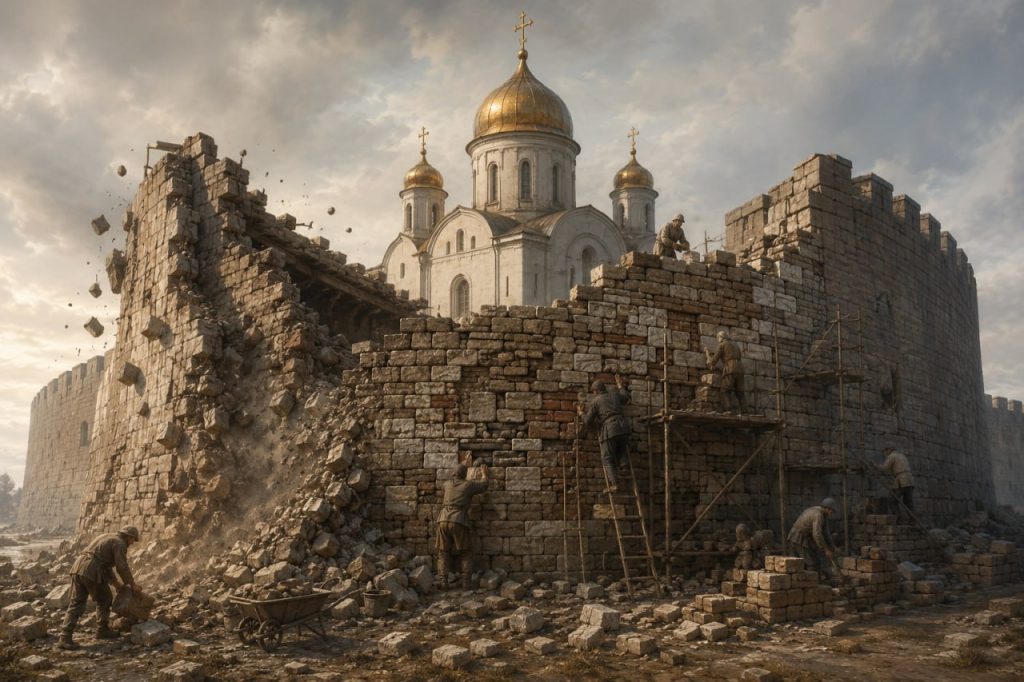
It is here, in my view, that one of the Church’s main challenges lies. The Church began by carefully fixing sacred meanings, then spent most of its existence accumulating prohibitions and taboos for those who were unable to comprehend those meanings but wanted to remain part of the church ecosystem – that is, it built scaffolding around its walls – and now it is engaged in presenting this scaffolding as, in fact, the ultimate meaning of the Church’s existence. In doing so, its basic mission is often forgotten: to help people acquire internal competencies, to become those “mature” people “who by constant use have trained themselves to distinguish good from evil” (Hebrews 5:14). Not by an order from above or by someone’s blessing, but by their own internal compass.
Modernity continues rapidly to remove external restrictions – informational, territorial, technological, social, and cultural. Therefore, a return to external control cannot be the Church’s long-term response. And in this respect, the Christian tradition possesses an enormous but largely underestimated stock of tools.
Skills the Church Knew Long Before the Emergence of Management
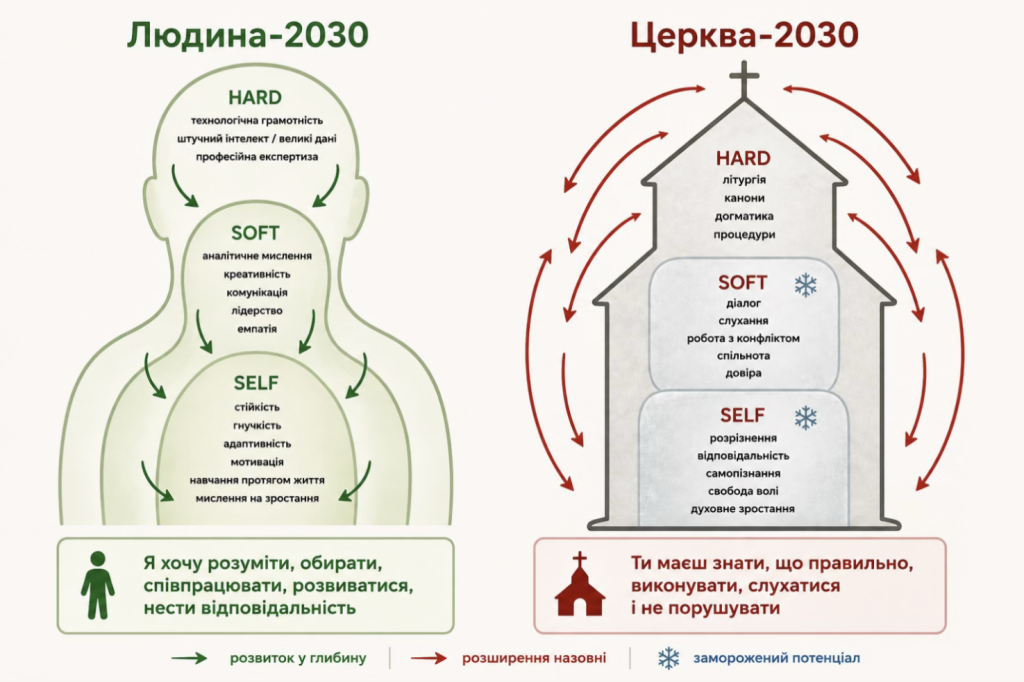
If we try to explain in contemporary language how the Christian tradition formed spiritual compasses, the closest example would be what education and management call the framework of skills and competencies: hard skills, soft skills, and self skills.
Hard skills are professional competencies and skills connected with specific processes, technologies, and methodologies: mathematics, logic, programming, foreign languages, professional competencies, and specialised knowledge necessary to perform a particular job.
Soft skills are social, communicative, and interpersonal competencies and universal skills that allow a person to adapt to change, interact effectively with other people, and find innovative solutions: the ability to communicate, cooperate, think critically and creatively, work with conflicts and in a team, and generate ideas. They may also be called metaskills because they help a person apply professional knowledge under any new conditions.
Self skills are skills of self-management: the capacity for self-analysis, or “digging into oneself,” responsibility, self-management, self-development, time management, emotional intelligence, and management of emotions.
Within this final group of skills, emotional intelligence stands out separately. It is a group of mental abilities that helps a person:
- manage their own emotions;
- control their reactions;
- interact better with other people;
- solve problems more effectively;
- withstand stress.
An important component of self skills is self-management – the ability consciously to organise one’s own behaviour, time, resources, and emotional state.
I think everyone familiar with the Christian anthropological tradition, particularly ascetic literature, has already understood where I am going. A significant part of what is today called, for example, self skills was already described in the Christian ascetic tradition in the language of virtues, passions, self-control, discernment, attention to oneself, and responsibility for one’s own thoughts and actions. It seems that contemporary science has not so much invented these competencies as redescribed part of a very ancient experience of human formation – only in a different language.
*If we consider virtue to be a formed quality of character that determines not only how a person acts but also for what purpose and what kind of person they become, then skills are precisely the toolkit that assists in the formation of Christian virtues, but not automatically.
Abba Dorotheos, the hesychasts, and countless other Christian authors spent centuries doing what today we would call self-observation, emotion management, discipline of attention, habit formation, responsibility, and work with motivations and internal conflicts. Thus, it is clear that long before contemporary science, the Christian tradition systematically worked with the same aspects of the human personality that management and psychology work with today.
The same applies to soft skills. For centuries, Christianity developed practices of listening, mentoring, reconciliation, communal life, conflict resolution, and mutual responsibility.
There is also the growth mindset – the belief that a person’s abilities and possibilities are not fixed once and for all, that a person can change through effort and learning. This concept also has obvious parallels with the Christian idea of spiritual growth: “though the righteous fall seven times, they rise again.” The question is not whether this is possible, but how many times you are prepared to try to do it again and again. This is precisely the foundation of readiness to learn and develop continuously.
The contemporary world increasingly values more than professional knowledge alone. Hard skills remain the necessary foundation of a profession, but a person’s and a community’s long-term competitiveness is determined by soft skills, self skills, and a growth mindset. They provide the capacity to learn quickly, adapt to change, work with people, and master new technologies throughout life. A church community that possesses no skills other than hard skills – memorised canonical prescriptions, liturgical texts, and homiletic clichés – has only one way of reacting to these challenges: reinforcing patriarchal consciousness and transferring all responsibility “upwards.” But those “at the top” are also people who possess no skills other than hard skills. An adequate response to such challenges, however, is the development of a horizontal structure and the delegation of rights and responsibility “downwards.”
Despite all the hymns of praise to “obedience, which is higher than fasting and prayer,” the medieval attitude of “surrender your right to decide for yourself to a superior church authority” not only contradicts the Christian understanding of freedom as a gift from God, but also transforms the will – the human capacity to realise this gift through responsible choice – into dependence on someone else’s decision. In the original ascetic tradition, obedience was a means of overcoming self-will and forming a mature, free will, whereas in the Russian hierarchical tradition – from which, in fact, this phrase “higher than fasting and prayer” comes – it was gradually reduced to unconditional submission to superiors, transforming a means of spiritual formation and correction of the human person into an instrument for maintaining the vertical structure of power – we will discuss this further below – and destroying human agency.
Why is this important? Because studies of the future labour market are already recording a shift in the structure of human competencies. According to the World Economic Forum, in its Future of Jobs Report 2025, by 2030, alongside technological literacy and specialised professional skills, increasing importance will be attached to analytical and creative thinking, resilience, flexibility, adaptability, leadership, social influence, curiosity, and the capacity for continuous learning. Thus, a person’s competitiveness will increasingly be determined not only by what they know and can do, but also by the extent to which they are able to learn independently, adapt, interact with others, and manage themselves. Is there any reason to doubt that post-war Ukrainians can fit this forecast perfectly?
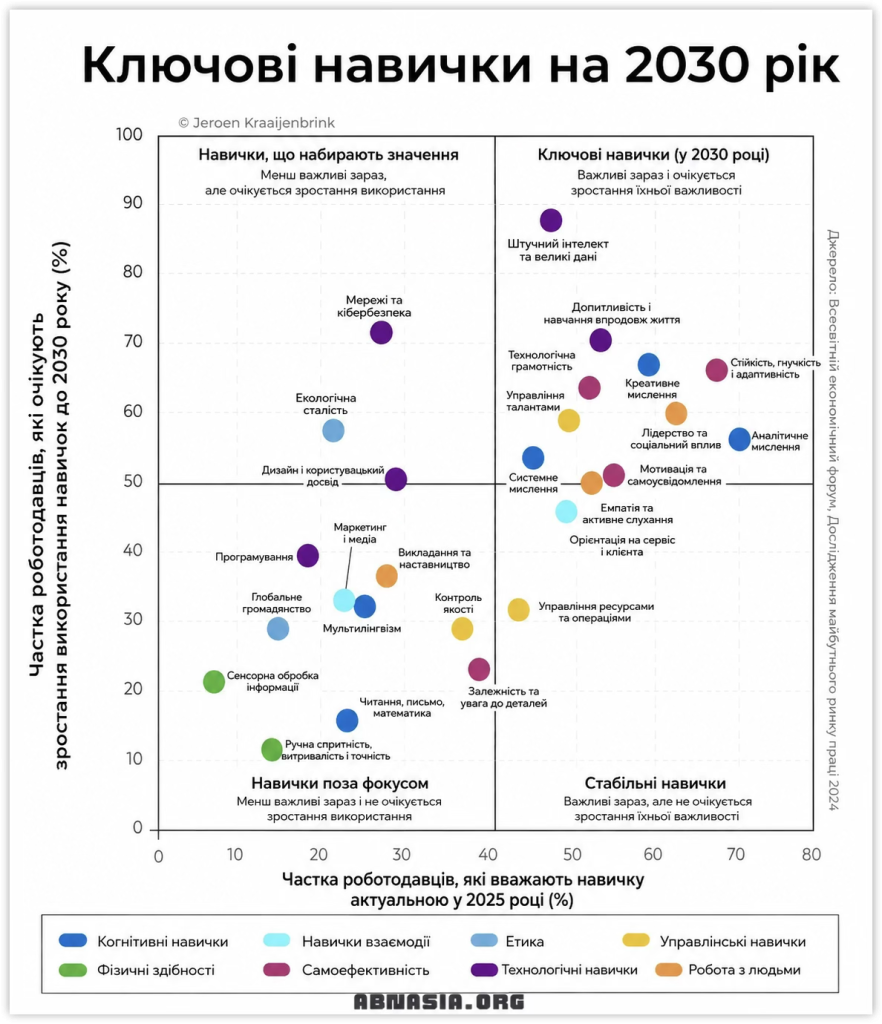
This means that in the coming decade not only the labour market but also the very type of person with whom church institutions work will change. People will come to the Church for whom skills of independent thinking, communication, adaptability, responsibility, and self-regulation will be necessary for professional and social survival. And here the question arises: is the Church prepared to interact with a person who has already learned to be an agent, rather than merely an obedient executor?
From Spiritual Experience to Canon
In this context, it makes sense to look from a different angle at the most conservative part of church life – canon law. There may be surprises waiting for us here.
I will begin with the fact that the canons did not arise as an abstract set of prohibitions for the sake of prohibitions. Behind them stand centuries of complex ecclesiastical experience: conflicts, mistakes, attempts to correct them, searches for the limits of authority, ways to protect the community from arbitrariness, and procedures for resolving disputes. They also represent the formation of the Church’s capacity for conciliarity, which defined the framework of its earthly existence. Conciliarity, incidentally, was embedded in church governance as “protection against a fool,” that is, against the usurpation of ecclesiastical authority by people who failed to cope with certain temptations and decided that they themselves were, in fact, the Church.
If we regard the canonical tradition as the result of the Church’s long experience under the action of the Holy Spirit – not as a mechanical “dictate,” but as inspiration – then the canons can be read as a kind of memory of the Church concerning how its life should be organised so that it remains the life of a community rather than the arbitrariness of individuals. In other words, through the development of canon law, for centuries the Church tried to create conditions for trust, responsibility, mutual recognition, and predictability.
But over time a dangerous substitution occurred. Initially, canonical order was a means of organising church life, while akribeia and oikonomia helped to fix individually whatever did not fit neatly within the rules. Then conformity to this order became an indicator that a church community was healthy and existed in proper ecclesial communion. And then what happened, happened: the indicator began to replace the reality it was supposed to indicate.
This does not concern all canons, or even the entire canonical system. An artificial selection took place: from the enormous and complex body of canonical tradition, a narrow list of structural markers gradually acquired particular importance – apostolic succession as an external fact, the correctness of ordinations, Eucharistic communion with other recognised Churches, one’s place in the diptychs, canonical territory, continuity of hierarchy, belonging to a particular jurisdiction, and mutual recognition of primates.
All these things matter, but they are only one part of church life. And here the question arises: why did precisely this set of markers become so important? What follows is only my reconstruction: the church system became too complex, the world began to transform intensively – let us recall the printing revolution – while the skills and competencies of church leaders, who relied on the omnipotence of sacred authority, no longer corresponded to the level of managerial tasks.
To manage complex systems, one must be able to see many interconnected variables, understand feedback loops, notice the side effects of one’s own decisions, and constantly adjust behaviour. If a management system lacks sufficient competence to work with complexity, it may begin simply to simplify the very object it is managing.
In the ecclesiastical case, this may have manifested itself in the reduction – simplification and narrowing – of the complex construct of ecclesial legitimacy to a set of features that are easy to verify, easy to administer, and easy to recognise mutually. Thus emerged the canonical façade familiar to all of us, which in turn changed the architecture of incentives within the Church – the system of rewards and punishments.
And now everything that is happening in contemporary Orthodoxy can be described by Goodhart’s Law: when a means first becomes an indicator and then an end in itself, it ceases to be a relevant indication of what it once measured or what it was originally intended for.
The problem is not that canonicity means nothing. Even in its reduced form, it remains a marker of “ours versus theirs,” which in an age of religious pluralism is already significant. But in terms of substance, it may cease to be evidence of high-quality, healthy church life.
Thus, one can say that a certain paradox arises with ecclesiastical indicators: whoever is incapable of developing in depth tries to strengthen the effect of external restrictions. Yet any external regulators should be temporary pedagogy, not the final goal.
How Do We Measure Ecclesiastical “Successful Success”?
A logical question arises: does the contemporary Church measure its success by the extent to which its people are already capable of spiritual life without external control? Clearly, religious organisations do not place key performance indicators at the centre of their management. Nevertheless, like any institution, the Church still measures something: the number of dioceses and bishops; parishes, churches, and priests; monasteries and monastics; the number of communities changing jurisdiction; place in the diptychs; territory; the total number of believers and the number attending particular events. In other words, key performance indicators do exist; they are simply almost all structural.
There are also some very peculiar indicators. A religious procession, if it is blessed by church authority and perceived as an act of ecclesiastical obedience, demonstrates the level of internal organisational mobilisation within the Church. This is a real competence of the system, showing the strength of the vertical structure, discipline, and the capacity rapidly to coordinate large numbers of people. But practice shows that high organisational mobilisation does not necessarily mean high internal agency among believers. The Church may be highly effective at gathering people on command, while being significantly less effective at forming people capable of diagnosing current problems, making independent choices, and assuming responsibility.
And here an uncomfortable question arises: what exactly do we call effectiveness, or success, in church life? Let us not use the Russian Orthodox Church as our benchmark in this matter, since it is said to have elevated its reporting and bureaucratic work to extraordinary heights in the absence of other criteria of church life. In my view, Patriarch Kirill, through his imitative activity, has transformed the Russian Orthodox Church into a simulacrum of the Church.
If we turn to the primary sources, however, it turns out that the Church does indeed have certain criteria. By what signs did Christ or the Fathers of the Church recognise a spiritually healthy community – not a “successful” one, but precisely a healthy one? The first thing that comes to mind is recognition by the fruits (Galatians 5:22–23). What kind of person does church life form? Does this person become more responsible? Are they capable of acting without constant instructions from above? Can they forgive? Are they capable of listening to others? Can they endure conflict without turning the other person into an enemy and themselves into an instrument of revenge? Do they possess a mature conscience? Are they becoming freer from fear? Can they be trusted not because of status but because of authority? Are they capable of creating a space of trust around themselves? These are no longer social key performance indicators. These are questions about whether church life is fulfilling its anthropological function.
The Church cannot “produce” a holy person. But it can give a person values, rules, tools, space, and experience – everything necessary for spiritual growth. Including the capacity for adaptation.
Self-Renewal Instead of Self-Preservation
At this point it is appropriate to recall the Italian economic historian Carlo Cipolla, author of The Basic Laws of Human Stupidity. Cipolla’s idea was that there are four types of people:
- helpless, or naïve, people: they act to their own detriment but to the benefit of others;
- intelligent people: they bring benefit both to themselves and to others;
- bandits, or villains: they act for their own benefit while harming others;
- stupid people: they harm others without gaining any benefit for themselves, or even while harming themselves. This is the most dangerous type of people.
At the same time, human experience shows that intelligence in itself does not protect a person from bad decisions – that is, from stupidity in Cipolla’s categories. An intelligent person may persist for years in doing something that harms both themselves and others. An institution can do the same, even one with a high level of public trust. The safeguard here is not merely intelligence, but adaptability: the capacity to receive feedback, question one’s own decisions, admit mistakes, open oneself to the new, and correct one’s behaviour. For the Church as an institution, this is particularly important: if it has a high capacity for mobilisation but low adaptability, it may become extraordinarily effective at reproducing its own mistakes, which over time turn into “sacred cows.” As a result, such an institution loses the capacity to distinguish fidelity to principles from fidelity to its own practices, in which mistakes have already accumulated, and is forced to spend ever more resources preserving the existing structure even when the original meaning has been lost.
In order to activate an adaptive mode, one must answer the following questions: is the Church capable of acknowledging that its current way of acting may not be optimal? Is it capable of learning? Is it capable not only of defending what has been handed down, but also of discerning which elements of what has been handed down are essential and which are historical forms? Is it capable of self-correction without regarding the very fact of change as a betrayal of itself? These are, in fact, questions from the growth mindset framework.
At present, we often see that the church system can be highly effective at preserving itself while at the same time being insufficiently effective at forming a mature, responsible, and adaptive person. Instead, in churches we often see a ritual reproduction of a dependent, paternalistic person oriented towards external authority. The world is removing external restrictions ever more rapidly. The response to this cannot be the endless accumulation of new restrictions and the construction of various mental walls.
Perhaps this is precisely today’s challenge for Orthodoxy: to become not a larger system, but a deeper one. The freer a person becomes, the more inner work they require. This means returning to the centre of church life not only the correctness of structure, but the quality of the human person. It means seeing the canons as a means. It means restoring to tradition the capacity to be a living transmission of experience. And, finally, it means ceasing to equate the self-preservation of the institution with the Church itself.