
Hennadii Druzenko, lawyer, civic activist
War is a lottery. No one knows whose house, apartment, or business will be hit tomorrow.
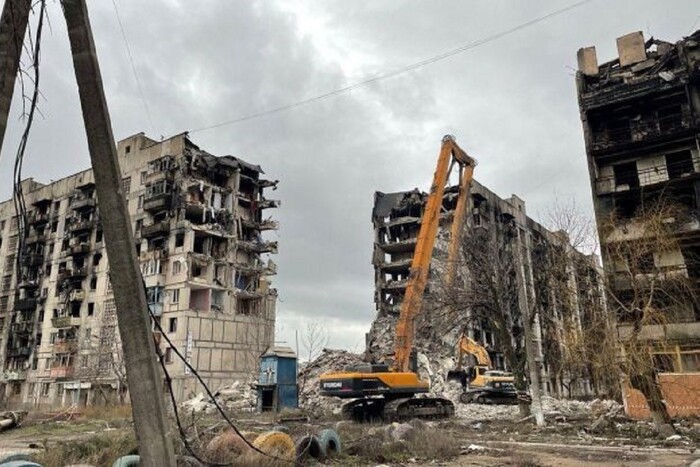
After its defeat in the Second World War, Germany lay in ruins comparable perhaps only to present-day Bakhmut, Soledar, and Avdiivka. Overall, 45% of the housing stock on the territory of the Third Reich was destroyed during the Second World War. Into these ruins poured a stream of refugees from the eastern German territories that, under the agreements reached by the victorious powers, were transferred to Poland and even to the Soviet Union – the Kaliningrad region. In total, this amounted to around 12.5 million people. Therefore, despite the horrific losses suffered during the war, the population of West Germany increased by 10% between 1945 and 1950.
Naturally, the war produced an unprecedented stratification of German society. Peasants and townspeople who had been fortunate enough not to lose their property in the war looked upon the refugees as enemies and treated them little better than Ostarbeiters. As journalist and historian Harald Jähner writes, “Locals, whether in Bavaria or Schleswig-Holstein, often resisted the accommodation of expellees so fiercely that these poor people could sometimes be moved into the housing designated for them only under the protection of machine guns…”
Clearly, a problem of such magnitude could not simply resolve itself. Historian Friedrich Prinz wrote: “A retrospective view, satisfied with the results of the integration [of post-war German society], sometimes makes it difficult to understand how close we came to catastrophe, because the German expellees could quite easily have become a problem for Germany similar to the Palestinian refugee problem.” The last large camps for expellees – internally displaced persons – were not emptied until 1966.
But soon after the founding of the Federal Republic of Germany, Germans realized that this glaring social injustice could destroy their newly restored statehood. They therefore began developing and debating a law on compensation for losses caused by the war. Three years passed in heated discussions. But the legislative act that eventually emerged as a difficult compromise – no stakeholder was entirely satisfied with it – became a symbol of political wisdom and foresight. In the words of the then leader of the German Social Democrats, the act was intended to “eliminate our internal guilt for the war before millions of our own fellow citizens.”
The law was based on the principle of social solidarity and justice: everyone who had suffered relatively little from the war was expected to support, at their own expense, those who had lost everything or almost everything. The law stipulated that property owners had to contribute 50% of the value of the property they owned as of June 21, 1948. This amount could be paid over 30 years in four equal installments per year. The beneficiaries of these payments were those affected by the war: citizens who had lost their homes as a result of hostilities, people with disabilities, and expellees.
Compensation was provided only for lost real estate and the fixed assets of businesses belonging to them, but not for lost cash or valuables. The compensation system was based on the principle of social justice: the percentage of compensation for the loss of substantial property was lower than for the loss of small estates. To determine the exact share of compensation to be paid to expellees and the burden of payments on contributors, compensation offices were created. They employed 25,000 officials and, over several decades of operation, processed 8.3 million applications for assistance from internally displaced persons alone.
In this way, the Germans, who after the war seemed to have once again fragmented into separate principalities, became a united nation for the second time and laid the foundations for their post-war economic miracle. It was precisely the expellees who became a driving force behind Germany’s economic revival: “From being a burden, the expellees soon became a valuable asset to the German economy. As a rule, they adapted to new circumstances more quickly and energetically than the native inhabitants of a particular region. Together with their property and their native homeland, they had also lost many illusions, which made them far more flexible and ambitious.”
Fortunately, the scale of the catastrophe that has struck Ukraine is orders of magnitude smaller. None of the major cities controlled by Kyiv lies in ruins like Berlin, Cologne, or Dresden did in 1945. If Ms. Vereshchuk is to be believed, we currently have around 5 million internally displaced persons. All of them have, to some extent, integrated into a new life, because unlike in post-war Germany, I know nothing of any present-day camps for internally displaced persons in Ukraine.
But a test of solidarity still awaits us. War is a lottery. No one knows whose house, apartment, or business will be hit tomorrow. Therefore, already today we must begin a difficult public discussion about post-war compensation for those from whom the war has taken everything or almost everything. Without relying on reparations from Russia. If they come – excellent. If they do not, will the law of the jungle really remain the supreme law in Ukraine: everyone for themselves?! If so, we will certainly never see a Ukrainian economic miracle.
Source: Glavkom