Authors and participants of the Summer School: Almira Nesipbaieva, Daryna Rasputna, Anastasiia Khomiak
Is it possible to learn, in five days, how to hold the line, save lives, weave protective charms, and crush enemy propaganda? At the Summer School of the “Youth for the Future of Ukraine” project in Varash, they proved that it is possible. Especially when you are part of the generation that will very soon have to rebuild this country.
Even though it is summer break, the alarm clock still mercilessly reminds me: it is time to wake up. I admit that getting up a little earlier than I would like during the summer is quite a challenge. Although I really have no right to complain: at least I sleep in my own bed. My new acquaintances have come to Varash from literally every corner of the country—from Lviv to Kharkiv—and for several days now they have been calling the “Varash” Hotel their home.
I walk along familiar streets, past places I know almost with my eyes closed, but this time even my hometown seems to look different, and I feel like a guest in it.
The first, still slightly hesitant introductions quickly dissolve into the scents of mint, lavender, and dried herbs. We make motanka dolls, carefully twisting the fabric and tying the threads, and it seems as though this hour has been created solely for peace and quiet. However, the peace does not last long.
My motanka has barely had time to take on a human shape when, just a few minutes later, I am already running across the school courtyard wearing a vest and carrying a rifle in my hands. No, there is no need to panic—it is only laser tag.
Although the excitement is entirely real. At this point, the lessons from “Defence of Ukraine” come to mind: tactics, cover, teamwork. While our opponents unsuccessfully try to “eliminate” us, we methodically advance. A shot. Another one. Someone loses a life on the scoreboard, while our team gains confidence and adrenaline. It seems that after this we might finally get a little rest.
Not quite.
Next up is a first aid workshop.
And now I am diligently performing cardiopulmonary resuscitation on a mannequin, mentally humming “Stayin’ Alive.” If specialists recommend this rhythm for chest compressions, then why not? The instructor smiles:
“Congratulations, the patient will live.”
At last, I can breathe a sigh of relief. At least today I have definitely saved someone.
After all that, even an ordinary lunch feels like a small reward. We quickly restore our energy and head to the Green Zone, where another, entirely different battle awaits us—an information battle.
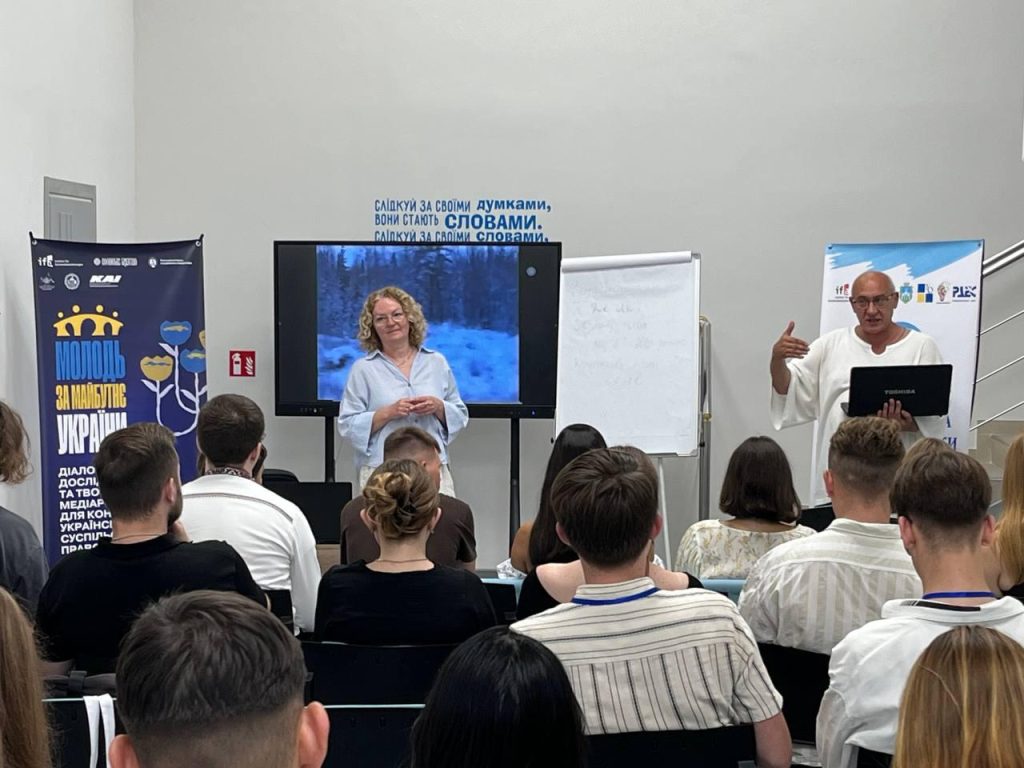
As the sun slowly disappears behind the pine trees, we talk about propaganda, cognitive biases, trust, information warfare, and how the media can do more than simply report the news—they can also help society stay united.
And as soon as the lecture ends, the participants collectively swap their notebooks for swimsuits.
A swimming pool, volleyball, hot shashlik, lively conversations, and laughter. It seems that this is exactly how communities are born. On my way home, I catch myself thinking that the day has passed suspiciously quickly. There are still more days ahead filled with interesting lectures, workshops, new impressions, and emotions.
The next morning, everything repeats itself: the alarm clock, coffee, the journey. Only the location is different, and the people already feel like our own. We recognize one another, smile, exchange glances and jokes.
We finish our morning coffee during the first lecture. We talk about fact-checking, artificial intelligence, social media algorithms, and why, today, being sceptical is sometimes far more useful than trusting without question.
Next, the group heads to the “Polissia” Information Centre, while this time I allow myself a little “journalistic walk.” Having been born in Varash, I have visited the centre many times before, so I decide to leave this opportunity to my colleagues from different regions. I hope they found it no less interesting to discover a city that has long since become familiar to me.
When we return, we change the format and get straight to work. We complete journalistic assignments, moderate discussions, and improvise so much that at some point our classroom turns into a real television talk show.
And the final meeting of the day quite unexpectedly begins to resemble a group conversation with a psychotherapist. We talk about conflicts, about home, about memory, about what the place you always want to return to smells like.
And it is precisely then that the realization comes: memory is usually not limited to photographs in a photo album or on a smartphone. Memory is born in emotions, in a circle of like-minded people, in that moment when a thought appears in your mind: “It would be good to spend another day like this.” We must preserve memory and create it, value it and nurture it. They say that those who do not know their past have no future. And we study the past in order to create the present that shapes our future. Because we are YOUTH FOR THE FUTURE OF UKRAINE.