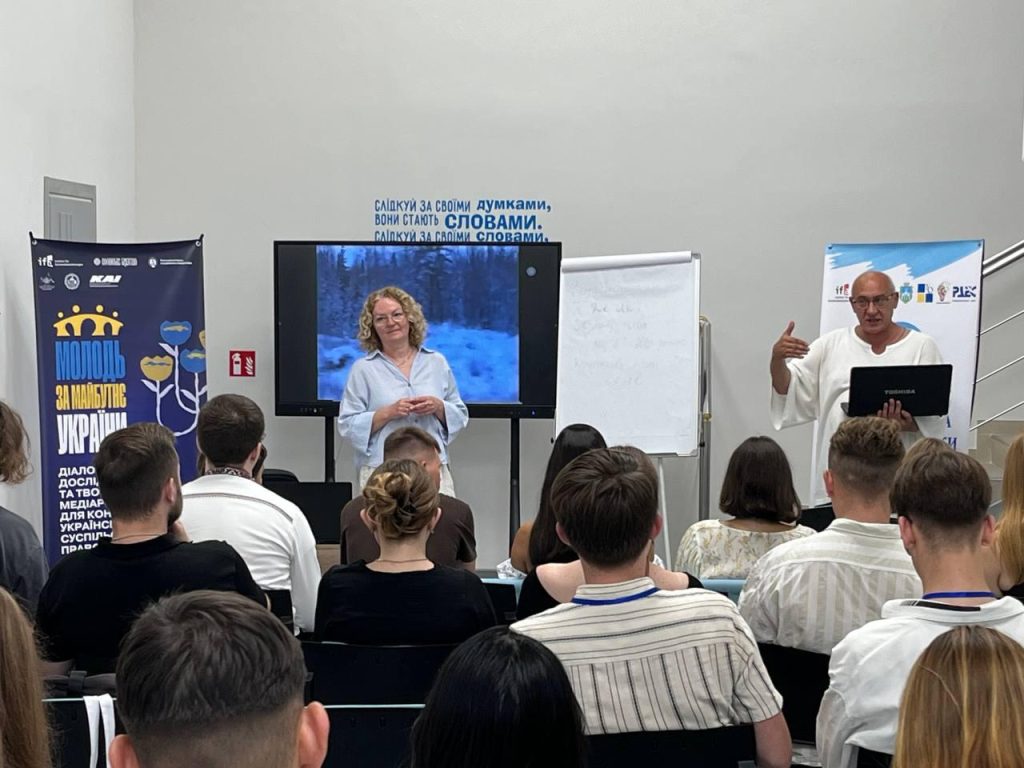
Authors and participants of the Summer School: Almira Nesipbaieva, Daryna Rasputna, Anastasiia Khomiak
Applying a tourniquet to a wound or recognizing a fake in your news feed – which of these saves more lives today? At the Summer School of Journalism in Varash, we came to a clear understanding: these skills are equally important. During wartime, words can both heal and become weapons of mass destruction. Disinformation operates according to the laws of a blast wave: it does not strike just one person, but an entire community. Protection against informational concussion is a skill that, unlike first aid, is still far from being taught to everyone at school. For us, the “Youth for the Future of Ukraine” project became an incubator where this gap is being closed at turbo speed.
One of the first activities was a game of laser tag. Running around with weapons and calculating the opponent’s tactics, you catch yourself thinking about the syndrome of a “toy war.” On the training ground, everything is simple: if you are “hit,” the sensor will signal it, you will reload and start again. In a game, there is always room for error and a conditional “new life.” In the information space, however, the rules are much harsher. A fake planted by the enemy and not recognized in time does not simply take away “life points” – it spreads panic, disrupts volunteer logistics, or demoralizes an entire city. There is no “restart” button here, and there never will be.
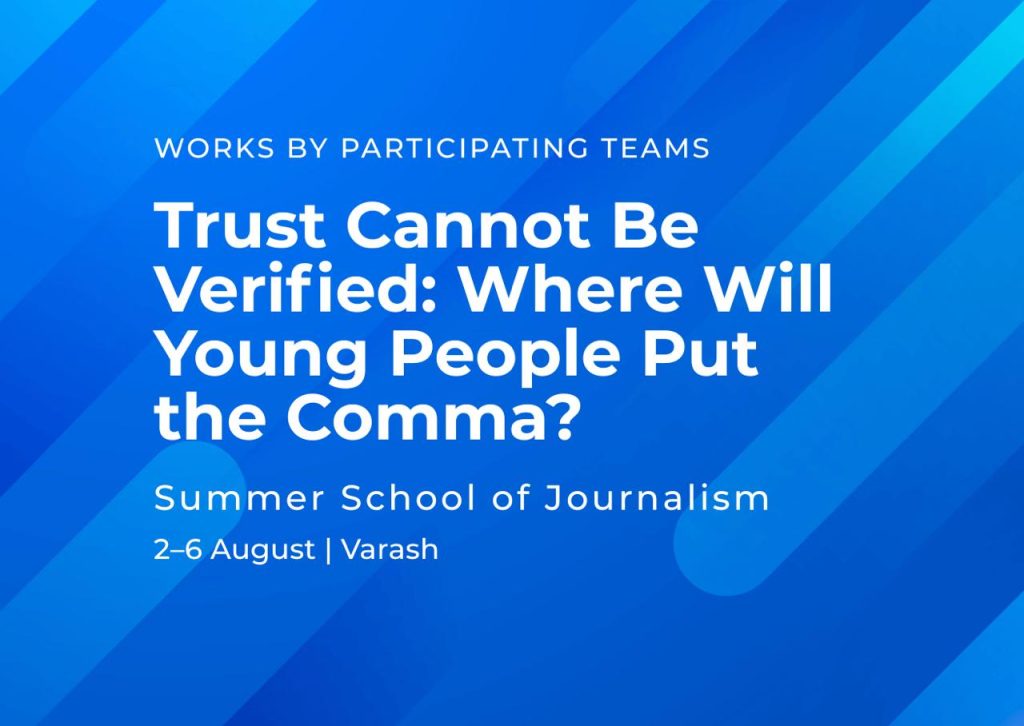
During wartime, society balances on a razor’s edge. On the one hand, there is the civic courage to speak openly about problems, corruption, or mistakes so that they can be corrected; on the other, there is the fear that your criticism will become fuel for enemy propaganda, which will instantly inflate a local scandal into an “everything is lost” narrative. The young people involved in the project have made their choice: “Trust cannot be, verify.” Fact-checking today is every citizen’s personal bulletproof vest.
And the statistics only confirm just how necessary this bulletproof vest is. In the autumn of 2024, more than 76,000 Ukrainians took the National Media Literacy Test – 5.5 times more than the previous year. More than 60 percent of participants were young people under the age of 35, while the 20–29 age group achieved the best results. At the same time, only 46 percent of participants demonstrated a high level of media literacy. These figures inspire optimism, but they also remind us that the test was taken by people who themselves wanted to assess their knowledge, so this is more an indicator of engagement than a portrait of society as a whole.
Even brief rapid surveys conducted during our meetings within the project demonstrate that we consume most of our news through Telegram channels and from friends. What is most dangerous is that even such a conscious and experienced segment of society as active young people does not always think about the original sources of this information. This creates a dangerous paradox: we consume more and more information precisely in the places where editorial responsibility is weakest, while algorithms are more eager to promote emotions than facts.
But how can we hold up this information shield when the news feed burns through our emotions every day? Unexpectedly, a cosy workshop on handcrafting a traditional herbal motanka doll became a tool of healing and mental grounding for us. When your fingers feel the aroma of dried medicinal herbs and your thoughts focus on an ancient tradition, the chaos in your mind subsides. It is impossible to analyse information and recognize manipulation when you are in a state of chronic stress or panic. The motanka became a symbol of preserving identity and of the silence that is vitally necessary for activating critical thinking. A calm mind is our first line of defence.
We conclude this intensive programme with a clear understanding of what journalism for Ukraine’s recovery should be. Our task as a new generation of mediators is to move away from journalism of “catastrophes and hype”; instead, the future requires words that build rather than destroy and defile. We can simply declare betrayal and give up, or we can illuminate complex changes in such a way that people see a way forward and want to become involved in rebuilding their communities. The future is not something we wait for; it is something we are constructing right now. And placing the commas correctly in the meanings we create is the first step towards our shared victory.