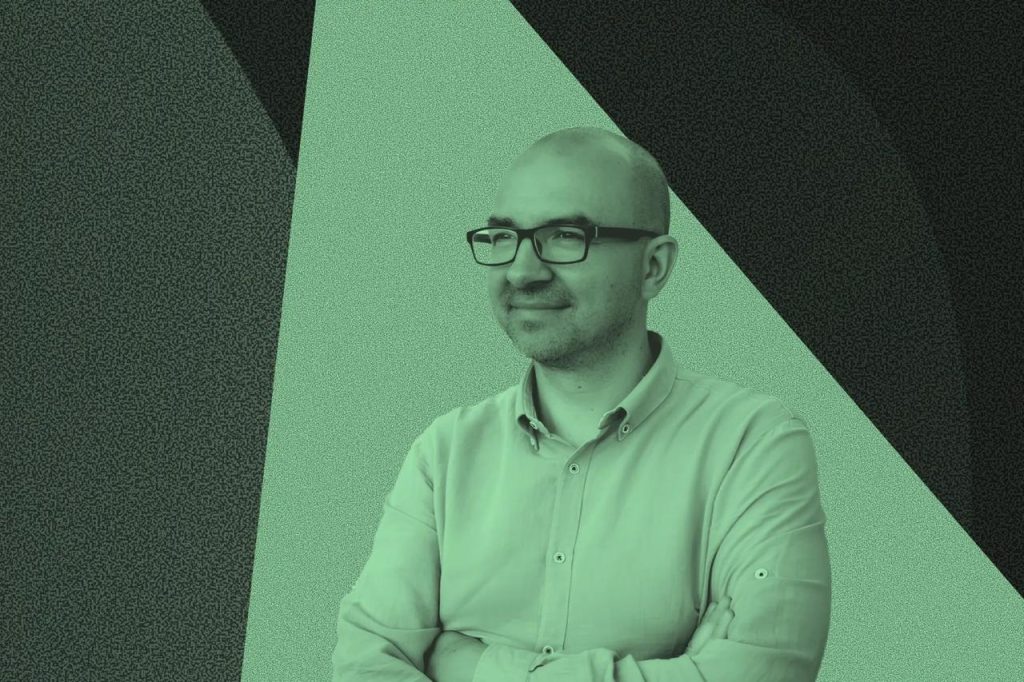
“Ukraine’s transformation of weakness into strength is not the cunning of ressentiment but a mythological transformation. It is how a child becomes an adult,” reflects Volodymyr Yermolenko – philosopher, writer, translator, and President of PEN Ukraine. In this essay, he explores why the current war is fundamentally asymmetric and how the anarchic spirit and horizontal social ties characteristic of Ukrainians can be both their greatest strength and their greatest vulnerability.
Volodymyr Yermolenko, philosopher, writer, translator, and President of PEN Ukraine
Life as a Journey of Transformation
Culture reveals several profound truths about human existence. Here are two of them.
The first is that we are thrown into a multiplicity of lives. We may choose a life and live it with dignity. We may also live with dignity a life we never chose. We may even attempt to contain several lives within one, living multiple biographies. Yet it is only through culture that we can touch countless other lives – dozens, hundreds, thousands. Experience cannot truly be translated, but without translating the experiences of others, understanding is impossible. This is why culture undertakes the impossible: translating the untranslatable. Only in this way can we become fully human – that is, beings capable of empathy.
The second truth is that life itself is transformation: an inevitable movement upward and downward, from nonexistence into existence and back again. Even if our own lives seem ordinary, devoid of great events, the very fact that they came into being is an astonishing transformation. Our bodies would be impossible without the formation of chemical elements through stellar fusion, without the transformation of inorganic matter into organic compounds, and without those compounds giving rise to living organisms. Within those organisms consciousness and self-awareness emerged, yet they are destined to perish and decompose, returning once again to the chemical elements from which they came. This transformation of death into life and life into death is the perpetual rhythm of our existence.
Culture constantly teaches us about these transformations. Novels, paintings, and symphonies all touch upon this mystery – the transformation of the hero, the journey inward or outward, upward or downward.
One of the central transformations found in myths, fairy tales, and legends is the discovery of one’s own strength: turning weakness into strength, overcoming both the weakness within oneself and an adversary stronger than oneself.
For the ancient Greeks, the hero served as a bridge between heaven and earth, eternity and mortality. Most heroic labors involve confronting an opponent more powerful than oneself. Hydras, Medusas, dragons, monstrous boars, infernal hounds, giants, and iron birds all symbolize the impossible. Heroes transform that impossibility into something that can be confronted and overcome.
Often, the mythological feat consists not merely in defeating an external enemy but also in overcoming an inner weakness. After Beowulf1 defeated the monster Grendel, he ruled the Geats for fifty years. Yet in old age he was forced to fight a dragon after most of his companions had fled. He confronted not only a stronger enemy but also his own frailty – his advancing age.
Other myths – or sacred narratives – tell the opposite story: the hero embraces weakness in order to discover true strength. Odin2 pierces himself with his own spear and hangs upon Yggdrasil3 for nine days and nights without food or water. As his flesh dies, the wisdom of the runes is revealed to him. Christ assumes human flesh and human mortality in order to experience the deepest suffering of humankind, for only such suffering can fully awaken the capacity for compassion.
The descent into the underworld is one of mythology’s recurring themes and is usually interpreted as a demonstration of courage. Yet we often overlook another dimension: the hero descends in search of something within the realm of the dead – the helplessness that will ultimately become a source of strength.
Immersing ourselves in our own weakness, fragility, mortality, and vulnerability may open the path both to our own strength and to compassion for others who are just as fragile and mortal as we are.
The Dance of Transformation
Friedrich Nietzsche described the magic of transforming weakness into strength with the concept of ressentiment. In his understanding, the weak take revenge upon the strong – not directly, but through cunning. Nietzsche believed that great theories and great religions became instruments of this cunning by teaching that weakness is virtue and that the weak are holy: be weak, help the weak, and you shall be saved.
There is, however, another kind of magic: transforming strength into weakness. Nietzsche called this nihilism – the decay of strength through the loss of confidence in itself, the shame of being strong.
Strength does sometimes become ashamed of itself, and it is a melancholy sight. Modern Europe often exemplifies this condition. It is embarrassed by its own strength. Instead of Václav Havel’s “power of the powerless”,4 Europe today is increasingly afflicted by what might be called the “powerlessness of the powerful.”
Europe possesses strength, yet distances itself from it as though it were an embarrassing relative. It politely asks its strength to sleep in another room.
Although Nietzsche was right about many things, in this respect he often misses the point. Ressentiment aptly describes the desire of the weak to take revenge upon the strong, but it fails to explain something fundamentally different – not how weakness pretends to be strength, but how it genuinely becomes strength.
In the Ukrainian experience, the transformation of weakness into strength is not ressentiment. It is not cunning. It is a dance.
A dance consists of movements in which every posture has meaning. When dance becomes martial art, every movement transforms weakness into strength, vulnerability into threat. What was once your weakness becomes your advantage.
Ukraine’s transformation of weakness into strength is not the cunning of ressentiment but a mythological transformation. It is how a child becomes an adult.
The foundational Ukrainian myth is embodied in the fairy tale of Kotyhoroshko: one born from something tiny suddenly begins to grow rapidly; one who emerged from obscurity suddenly changes the course of history.
Closely related is another myth – that of the “sleeping giant”,5 as Ostap Tarnavsky6 called it. Ukrainian cultural tradition is filled with images of the hidden hero who, when confronted with an existential threat, rises to defend the life of the nation.
Russian culture, by contrast, is the culture of a cursed circle, in which every attempted transformation ultimately reproduces tyranny – a thanatocracy, rule through death – whether left-wing or right-wing, Orthodox or atheist. Against this background, Ukrainian culture possesses the possibility of following a different path: one of awakening, profound transformation, and the conversion of weakness into strength.
Whether it succeeds depends entirely on us.
Why Democracies Decline
Human weaknesses are often the reverse side of human strengths. The same is true of societies.
The very principles that make societies strong can, at a certain point, become the cracks through which they begin to fall apart.
Polybius – the Greek historian who wrote during the era of Roman expansion – was especially interested in understanding why democracies decline. Why did his native Greece, the world of democratic city-states, become powerless before Macedonian and later Roman conquest? Why do free societies, driven by liberty, suddenly disintegrate into anarchic communities where everyone pulls in their own direction?
Democracies enter into crisis when citizens begin to treat freedom not as something that must constantly be defended, but as an inheritance – as property that will always belong to them.
In the best case, they continue to believe in freedom but lose the willingness to defend it. In the worst case, they dismiss it as an outdated cliché that can simply be thrown away during the next renovation.
Democracies begin to decline when they become hereditary.
Polybius admired the strength of the young Roman Republic and described its mixed constitution as the ideal political system. Nearly two thousand years later, Montesquieu explained why that same Rome became weak and how its weakness emerged precisely from its strength. The virtues of Rome, the civic character of its citizens, the balance between monarchy, aristocracy, and democracy, and its remarkable capacity to conquer and administer new territories eventually caused the state to expand beyond what could be effectively governed. At the same time, the Republic’s internal solidarity eroded under the growing influence of victorious military commanders.
This dialogue between Polybius and Montesquieu7 across two millennia is itself an illustration of how culture works: a conversation across time and space that transcends the multiplicity of lives and deaths.
When Montesquieu discusses the republic in The Spirit of the Laws, he warns that the very principles on which free societies are built – liberty and equality – can also become the source of their decline. This happens when these values are carried to excess. One person’s unlimited freedom begins to undermine another’s, while the demand for absolute equality destroys the hierarchies that are sometimes necessary.
Horizontal relationships require vertical ones – and vice versa.
The greatest strength of democracies lies in the idea of rights: the conviction that every citizen possesses dignity and rights. Yet democracies begin to die when they stop there, when citizens forget that one person’s rights limit another’s, that the security of the community grants rights but also imposes obligations, and that even the most horizontal societies require someone to serve as first among equals.
Asymmetric War
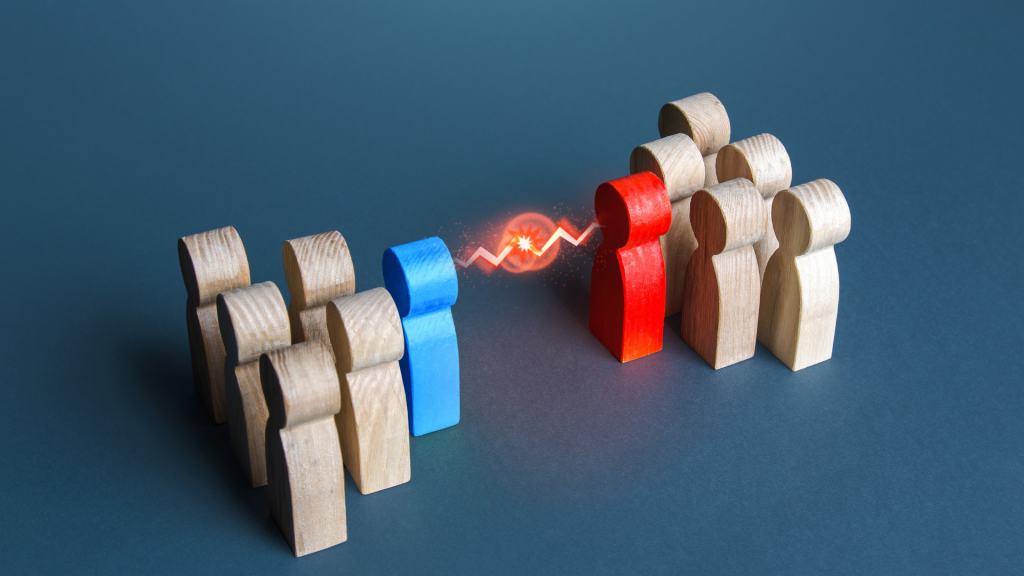
The question of strength and weakness is also the question of the current war. It is the question of asymmetry.
An asymmetric war is one in which you transform your opponent’s strengths into weaknesses.
In conventional conflict, you search for your enemy’s vulnerabilities and strike them. In asymmetric warfare, you identify your opponent’s strengths and seek to turn those strengths against them.
The highest level of mastery is achieved when you transform your opponent’s essential strength into their greatest weakness – when they begin to perceive not some accidental flaw but their very identity as their principal liability. At that point, they lose confidence in themselves, and that loss of faith becomes the beginning of defeat.
Russia is waging precisely this kind of asymmetric war against Ukraine. It is pursuing the same strategy against other democracies. Its objective is to transform democracy’s greatest strengths into its greatest weaknesses – to turn democracy against itself, making freedom’s finest qualities instruments of self-destruction.
Democracies became vulnerable when their core values came to be associated primarily with the political establishment. When freedom and equality began to be championed mainly by those already at the top of the social pyramid. When these values ceased to be ongoing tasks and instead became finished achievements – objects rather than living processes.
But freedom and equality can never become possessions that we capture once and for all. They are birds that can always fly out the window. They are rivers that never stop flowing.
A democracy enters crisis the moment people believe that freedom is safely tucked away in their pockets.
Or when they imagine freedom to be another item in their wardrobe, another feature of their landscape design – as though values could remain permanently where they have been placed.
The Strength of Conflict
The strength of democracy lies in the freedom of its citizens – in their ability to realize their highest potential. For that reason, democracies function not as a single organism but as a flock.
Democracy is a swarm. Democratic societies therefore operate as heterogeneous environments filled with constant disagreements. Paradoxically, these conflicts also generate resilience, creating space for unexpected solutions and innovation.
The strength of tyrannies, by contrast, lies in the subjugation of their subjects – in the willingness of individuals to surrender their individuality and sacrifice their bodies, minds, and lives in order to form a single clenched fist. The supreme virtue of a subject under tyranny is the ability to understand the ruler’s wishes and obey them. The so-called “great” rulers of tyrannies derive their strength from concentrating the will of others within themselves.
Consequently, intrigue becomes the central narrative of tyranny. When positions are predetermined by the system, success depends upon conspiring against rivals in order to obtain or preserve one’s place.
In democracies, people are capable of creating new places for themselves. They create their own symbolic geography instead of merely occupying positions that already exist. Therefore, imagination – not intrigue – is the defining force of democracy. Conflict is woven into the very fabric of democratic life. Plurality is both its source of vitality and its greatest danger. The challenge for democracies is to harness the creative power of diversity without allowing it to become destructive.
When competing forces remain balanced and continue to struggle with one another, they preserve the system in a state of dynamic equilibrium. Once that balance is lost, the system rapidly begins to destroy itself.
Throughout the twentieth century, attempts to dissolve political struggle into a supposedly “higher synthesis” – the illusion of a final unity that resolves every contradiction, heals every conflict, reconciles every wound, and forgives every injustice – produced crises and catastrophes. Marxism sought to eliminate conflict through the dictatorship of a single class, which was expected to culminate in a classless society. Capitalism, in turn, placed excessive faith in the “invisible hand,” believing that competition itself would eventually eliminate all contradictions.
Yet democracy must remember that conflict is inevitable within pluralistic societies. Its goal is not to abolish conflict but to prevent it from descending into disintegration. The objective is not to eliminate disagreement but to ensure that disagreement does not destroy the whole. Joseph Schumpeter’s8 celebrated “creative destruction” must never be allowed to become destructive creation.
Ukrainian Anarchism
There are key traits of Ukrainians that may become the source of either our triumph or our collapse. It depends on us whether we turn them to our advantage or against ourselves.
The first of these traits is Ukrainian anarchism. Anarchism does not mean chaos. It means the absence of a single source – an archē. Ukrainian anarchism is in fact polyarchism: the presence of many roots, many sources.
Anarchism looks at a tree and sees not its trunk, but the branching network of its roots – a rhizome. Its strength lies in multiplicity: each root seeks its own path toward the good, yet together they nourish the tree.
Unlike the idyll of “multicultural” societies in peacetime, however, we understand that multiplicity does not always lead to peaceful coexistence. It can be threatening, abrasive, and unpleasant. We also see its repellent face.
It is important to perceive wholeness behind this multiplicity. We may be different pieces on the chessboard, but we share the same chessboard.
Despite being a continental country, and although the Black Sea has almost no islands, Ukraine resembles Aegean Greece: an archipelago in which every island possesses a certain degree of autonomy. The Ukrainian concept of the kurin – a word of Turkic origin – or the Ukrainian concept of the hromada, which in Drahomanov’s thought is very close to the Greek polis, reflects this reality.
The word archipelago means “chief sea.” It originally referred to the Aegean Sea, the principal sea of the Greeks. But because it was filled with islands, the word gradually came to mean a network of islands.
Ukrainian an-archy is strangely connected with the archi-pelago. We reject a single source of power, yet we understand that our political community itself is our “chief sea.” We deny the archē and affirm it at the same time. It is important to keep this in both mind and heart.
Our second trait is localism. It is a source of strength: we love cultivating our own garden and tend to regard it as the best. But sometimes this fierce love of what is ours produces an equally fierce hatred of what belongs to others. The problem is that, for us, the “other” often begins very close by. It nearly coincides with the neighbour.
We sometimes fight so fiercely against those closest to us that we forget where the force that truly threatens us is located. Struggle and competition generate new ideas and solutions, but at times we lack the ability to understand how much we need those who stand in our way.
We must also remember that foreign institutions shape our characteristics. Our institutions were not created by us. They are like the Commander’s cloak that Don Juan puts on in Lesia Ukrainka’s The Stone Host: they were not tailored for us. We disappear inside them, and they kill us.
Foreign imperial institutions demand obedience. Living Ukrainian society is nourished by disobedience and creative restlessness.
The state still seeks primarily to control. Instead, it should not only control what already exists, but also stimulate what does not yet exist. It should support what is alive, or what has the potential to live.
Our natural condition is horizontal, semi-anarchic, and Cossack-like. Even the army – the most hierarchical organism in any society – resembles in Ukraine an archipelago of small armed forces, each of which is an autonomous principality with its own leadership, flag and coat of arms, economic base, sources of funding, ideology, and even external relations.
To build this organism as a single hierarchy is a hopeless undertaking. Our path is to build it as a living interaction governed not by tyrants, but by those who are first among equals.
If Russian society is built like an army, then in Ukraine the army is built like society.
The Russian saying, “Do not think yourself safe from prison or beggary,” means that one must always be prepared to end up imprisoned or destitute. This sensibility is fundamentally different from the Ukrainian worldview, according to which one must always strive for sloboda and freedom: a prosperous household and a free life.
Tyrannies are built upon a religion of destruction. Their ideology is thanatocracy: the belief that death and the fear of death are the best instruments for governing and constructing order.
Republics such as Ukraine are built on the belief that the chaos of creation is better than the order of destruction. That a garden, even if tangled and chaotic, is better than an orderly wasteland.
A Single Organism
Our anarchism is a source of our strength and agency: we are responsible for ourselves. We also defend ourselves.
But this agency is often directed inward and confined to one’s own hamlet and garden. The Ukrainian word svoi – “our own people” – cannot be fully translated into every language because it denotes not merely a collective identity, as in “ours,” but a collective identity in which the personal and communal merge.
Yet the word svoi also carries a tribal quality. By producing a sense of group identity, it also produces enemies. The production of enemies is one of humanity’s favourite games, and we are unlikely ever to stop playing it. But for a society’s self-preservation, it is crucial that enemies – the “strangers,” the “not ours” – do not begin in the neighbouring village.
The war generated an enormous consolidation of Ukrainian society, but cracks soon began to appear in that consolidation. We started forming groups, each carrying its own truth on its banner.
We may fail to notice the moment when we begin devouring one another.
Russia will not defeat us on the battlefield. But we may defeat ourselves.
Throughout our history, anarchic spirit and horizontal organization have often constituted our deepest essence. Yet they have also been our greatest weakness. They generated creativity and self-assertion, but also their own shadow: the inability to reach agreement, the fragmentation of forces, the rejection of authority, the multiplication of conflicts, hatred of the aristocracy, and eruptions of uncontrolled violence.
It is time to transform this horizontal character into strength.
It is time to develop models of coexistence in which our spontaneous and plural creativity does not destroy order, but creates it.
We speak a great deal about resilience, and rightly so. But we must speak no less attentively about our fragility. These are often two sides of the same reality. When we try to solve one set of problems, we must continually think about how not to cause harm or create new ones. We must ensure that group identities do not become ever narrower and begin to undermine national identity.
If we lose the sense of being a single organism – even one containing profound disagreements and internal conflicts – and if group identities continue to fragment, we may end up in a war of all against all, one of the central curses of Ukrainian history.
That would be the path to defeat, not victory.
Source: Ukraїner
- Beowulf is an anonymous Anglo-Saxon, or Old English, poem dating from the seventh to the ninth centuries. It was given the name of its central hero in 1815. It is currently the only fully preserved work of such length written in Old English. According to the plot, Beowulf accomplishes three heroic feats but ultimately dies from wounds received in an unequal battle. [↩]
- This refers to the myth of Odin, the supreme god of Germanic and Norse mythology, who created the universe, humanity, and the elements, and later became the god of war, seafaring, and trade. [↩]
- Yggdrasil is, in Norse mythology, the sacred tree – most often depicted as a gigantic ash – that connects the nine worlds and serves as the axis of the universe. [↩]
- This refers to Václav Havel’s seminal 1978 essay The Power of the Powerless. Havel was a politician, dissident, and civic activist who served as President of Czechoslovakia from 1989 to 1992 and President of the Czech Republic from 1993 to 2003. The essay concerns the struggle of the individual for their rights in a post-totalitarian world. [↩]
- Ukrainian intellectuals most often used this expression to refer to the Ukrainian people or Ukraine, whose great strength had long been suppressed. [↩]
- The source is Ostap Tarnavsky’s collection of essays Longing for Myth, published in New York by Kliuchi in 1966. [↩]
- Charles-Louis de Montesquieu (1689–1755) was a French jurist, thinker, and writer. He was one of the intellectual founders of the modern theory of representative democracy. [↩]
- This refers to the concept of “creative destruction,” a theory developed by the Austrian-American economist Joseph Schumpeter, according to which economic development takes place through continual renewal. [↩]