
It is a dynamic condition of society that requires shared, unifying solutions – often uncomfortable ones.
Maryna Starodubska
During the annual conference of the Georgiy Gongadze Prize, Media Days, I spoke on the discussion panel “Liberated Territories and Post-War Ukraine: The Role of the Media in Mediation and the Reintegration of Society,” where we discussed the characteristics, drivers, and emergence of polarization, as well as its impact on society. For a long time, I had wanted to reflect systematically on this topic through a cross-cultural lens, but I lacked the stimulus that would ultimately result in a structured product. This presentation became precisely that stimulus. In addition, the recent study of affective polarization in Ukrainian society conducted by the Kyiv School of Economics and the Civic Network OPORA with the support of USAID found moderate levels across potentially polarizing issues. The findings were widely shared on social media, often accompanied by comments such as, “Everything is fine – we do not have polarization.”
The fear of acknowledging that our society is polarized, or at least prone to polarization, becomes apparent every time this subject is discussed. It is as though polarization were an indecent “disease” or a sign of our society’s “underdevelopment” or “immaturity.” We seem to need confirmation – a kind of certificate – that polarization does not exist, as though that would mean one less societal problem to deal with. However, until we destigmatize polarization as a condition to which our society is naturally susceptible and begin to see it as a challenge rather than a diagnosis, it will be difficult to address it effectively. Let us therefore examine what polarization is, how it influences social processes, and, in the long term, how it shapes the national mentality.
Polarization is defined1 as a process that arises between different groups of people whose members share similar perceptions of social reality through common values, norms, and narratives. These groups, however, differ in how they perceive social problems and exhibit mutually negative emotional attitudes toward one another. Contemporary scholarship views polarization as consisting of two interrelated components that were previously regarded as separate forms of polarization: affective polarization and issues-based polarization2.
Illustrative examples of polarization would be the statements: “I hate the traitors who left the country” (affective polarization) and “I support the decision to deprive Ukrainians living abroad of access to consular services” (issues-based polarization). In the first case, we are dealing with a stable and strong negative emotion directed toward a particular social group. In the second, we are dealing with a position on a specific policy or decision that is shaped by that emotional attitude.
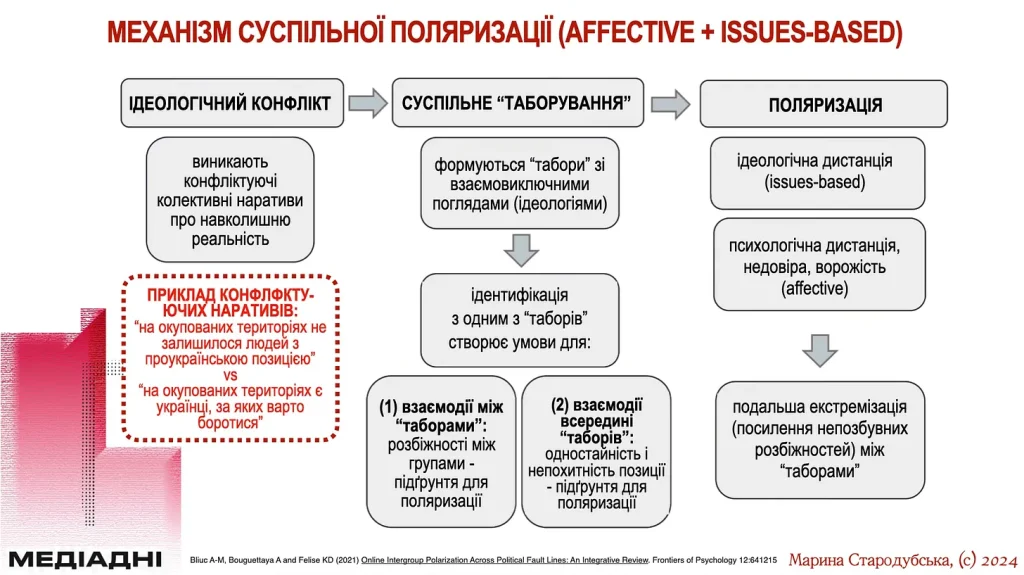
Let us now consider how polarization develops, as illustrated in Figure1 below.
The process of polarization always begins with an ideological conflict – mutually exclusive beliefs held by different social groups about social reality, which generate corresponding narratives. Different segments of society then cluster around those narratives that resonate most closely with them. The more unanimous and uncompromising each “camp” becomes internally, and the wider the gap between opposing positions, the deeper the polarization of society.
Importantly, polarization does not necessarily result in intergroup hatred or social fragmentation. However, the likelihood of these outcomes increases when 3:
- Society contains groups with different worldviews that are relatively comparable in size and strength of conviction. If one group is overwhelmingly larger than the others, or if the differences between groups are relatively minor, there is little around which polarization can develop.Example: “Economic exemptions from military mobilization preserve jobs that are critical to the economy and therefore strengthen the country during wartime” versus “Economic exemptions are an instrument of social inequality, whereby the poor serve while the wealthy avoid mobilization.”
- There is significant ideological and psychological distance between groups with differing worldviews, making interaction and compromise more difficult.Example: “When will those who left abroad stop complaining? If things are so bad, they should come back,” versus “You have no idea how exhausting it is to live in a foreign country when everything you built throughout your life is inaccessible or has been lost.”
- Groups define themselves in opposition to one another or to a particular social issue.Examples: “Porokhobots” versus “Zelebots” in Ukraine; “draft dodgers” used indiscriminately to describe everyone who left the country rather than only those who violated the law; or “Trumpists” versus “wokists” (derived from the term woke and used pejoratively to describe progressive or left-leaning people) in the United States.
At first glance, the best way to determine whether a society is polarized would seem to be to ask people directly. Although such surveys are methodologically valid, several contextual factors must be taken into account.
Ukraine is a relationship-oriented and deeply distrustful culture characterized by high power distance and strong uncertainty avoidance. In such cultures, what people say, what they genuinely believe, and how they ultimately behave tend to diverge more strongly when the social ties between participants in the conversation are weak. Consequently, survey methodologies based on direct questions such as “How do you feel about a particular group of people?” have important limitations in a culture where approximately half of the population believes that “it is safer not to trust anyone.” Responses – particularly negative ones – may therefore be significantly softened.
Accordingly, if a country does not conduct regular measurements of polarization itself, it is useful to examine sociological indicators of broader social phenomena whose manifestations signal a high probability of polarization.
The special report Edelman Trust Barometer: Navigating a Polarized World (2023) contains an infographic mapping the risks of polarization across different countries – from the threat of polarization to deeply entrenched polarization – and identifies the principal factors influencing its severity.
As the figure demonstrates, polarization is driven most strongly by distrust in government and the absence of a shared identity (that is, identity exists, but is interpreted differently). A perception of systematic social injustice exerts a moderate influence. Economic pessimism, political fears, and distrust of the media also contribute significantly, although to a somewhat lesser degree.
Let us now examine empirical evidence for each of these factors using recent studies of Ukrainian society.
Distrust in government. Overall, 77.4 per cent of Ukrainians distrust public officials; 72.5 per cent distrust the government; 70.2 per cent distrust the judiciary; 62.6 per cent distrust the prosecutor’s office; 78.5 per cent distrust the Verkhovna Rada; 51.1 per cent distrust the National Agency on Corruption Prevention; and 70 per cent distrust the National Anti-Corruption Bureau. Ironically, distrust of government is one of the few beliefs that strongly unites Ukrainians.
Lack of a shared identity. Ninety-five per cent of citizens identify themselves as Ukrainians. For 46 per cent, Ukrainian identity is independent of ethnicity, while 28 per cent regard it as an ethnic category. The strongest unifying forces are hope for a better future (52.7 per cent) and the shared experience of losing a normal life (39.5 per cent). Mutual accusations, meanwhile, are regarded as one of the principal sources of social division (59 per cent).
Perceived systematic social injustice. A total of 55.7 per cent believe that strong leaders can accomplish more for the country than laws and public debate; 42.8 per cent believe that their lives depend primarily on external circumstances, whereas only 27.4 per cent believe they depend primarily on themselves. The current level of social cynicism stands at 61.9 per cent, while 56.3 per cent believe that justice is not ensured in Ukrainian society.
Economic pessimism. A total of 64.5 per cent describe Ukraine’s economic situation as either “very poor” or “rather poor.”
Political fears. For 62 per cent of respondents, political conflict is the primary cause of social division.
Distrust of the media. Forty-seven per cent trust the media, compared with 53 per cent in 2023 and 58 per cent in 2022.
These findings indicate that significant points of tension unquestionably exist within Ukrainian society. Whether they evolve into genuine social ruptures depends on the effectiveness of formal institutions, government communication, and the willingness of community leaders to seek compromise.
Before turning to practical recommendations, however, it is useful to consider how polarization can be measured methodologically in order to understand both its depth and its severity.
According to current scholarship, polarization can be assessed using nine principal indicators2.
- Spread – How wide is the range between existing social beliefs on a given issue, regardless of which groups hold them? The broader the range of competing beliefs, the greater the degree of polarization.
- Dispersion – How evenly are different levels of belief distributed throughout society? The less evenly distributed these beliefs are, the greater the polarization.
- Coverage – How much of the spectrum of possible opinions remains unrepresented by existing public beliefs? The lower the coverage, the greater the polarization.
- Regionalization – To what extent is the full spectrum of beliefs represented across society regardless of group membership? The narrower the represented spectrum and the greater the differences between beliefs, the stronger the polarization.
- Community Fracturing – How many groups with poorly compatible belief systems exist within society? The greater the number of such groups, the higher the degree of polarization.
- Distinctness – To what extent do different social groups share common characteristics such as values, behavioural norms, lifestyles, or size? The fewer common characteristics they possess, the stronger the polarization.
- Group Divergence – How fundamentally different are the values and norms that shape the beliefs of different social groups? Greater differences indicate greater polarization.
- Group Consensus – How consistently do members within each group adhere to shared beliefs, and how much internal diversity exists? The lower the diversity within groups, the stronger the polarization.
- Size Parity – Are there several groups of roughly comparable size competing with one another, or is one dominant group overwhelmingly larger than the rest? Polarization is strongest when competing groups are similar in size and strength.
The practical implications of these findings – and the particular features of the Ukrainian national mentality that shape them – deserve separate consideration.
And what about the practical steps and the features of our mentality that influence them?
First of all, it is worth taking into account that polarization is a complex and all-encompassing phenomenon, and therefore it must be addressed through measures of a comparable scale. Moreover, Ukrainian society has always been, and will remain, highly prone to polarization, because a country with such a history of territorial formation cannot have a population that thinks homogeneously. Our tendency to live in separate “bubbles” is historically rooted. Therefore, we are unlikely to “cure” polarization, but we can certainly reduce its manifestations.
Let us begin with the particular features of our mentality.
1. Our relationship-oriented culture is “fuel” for polarization.
According to the Lewis model, we are a multi-active culture; according to Hall’s model, a high-context culture; and according to Gelfand’s model, a moderately “tight” culture in terms of social norms. A sense of shared worldview and personal “resonance” are of primary importance to us. Therefore, we find it difficult to accept even professional and effective decisions from people whom we do not like.
2. “Criticism before appreciation” as one of the manifestations of our mentality.
For us, “sincerity” means saying negative things directly to someone’s face, while criticism focuses on the source of the problem, those responsible, and their punishment. We have a strong need to “ventilate” negativity publicly, because this is how we seek groups that share our beliefs.
However, we praise or publicly support others exponentially less often because, in societies characterized by distrust, such communication is regarded either as insincere or as having been “incentivized.”
3. Comparable expressions of “universalism” and “benevolence.”
Universalism means a demand for justice, equal rules, and the rule of law, while benevolence means concern for the well-being of “one’s own people.”
The closer the relationships within a group, the more leniently requirements are applied and the broader the discretion to forgive improper conduct. The attitude toward people outside the trusted circle is entirely different.
On the one hand, an unmet demand for justice has accumulated over several decades. On the other hand, different “bubbles” interpret this justice differently, often from the position of “what is convenient for me” rather than “how this decision will apply to everyone.”
4. Low social trust, which will remain low for a long time.
Every idea or reform has a face, a first name, and a surname. If people do not like that person, the idea will not receive sufficient support.
We trust neither the authorities nor the media, which rank sixth in levels of trust after family, friends, the General Staff of the Armed Forces of Ukraine and the Ministry of Defence, colleagues at work or study, and social media. Nor do we trust people with whom we have no relationship.
Therefore, decisions and changes that affect the whole of society risk being rejected unless they are competently explained and “sold” to different communities, purely according to the principle of “one of us” versus “an outsider.”
5. Perfection as a basic requirement for leaders and fundamental reforms.
Periodic mistakes and failures become reasons to devalue a person, action, or “product” because it is not perfect.
The “either-or” position, also colloquially described as “black-and-white thinking,” is characteristic of threatened and distrustful societies. In such societies, one way of avoiding danger and public condemnation is to resort to simplified solutions and reasoning.
We often seek idols whom we want to “worship” rather than leaders who will make difficult and unpleasant decisions for everyone, however necessary those decisions may be.
This condition of society has a scholarly name: naive realism. It is a situation in which citizens attribute decisions they approve of to “good” people and decisions they disapprove of to “bad” people, regardless of whether the decision itself is correct.
6. Group affiliation and the demonstration of status as protective mechanisms.
“Are you with them or with us?” and “We are better than them” are attitudes that narrow our opportunities for dialogue between “bubbles.”
A total of 65.2 per cent of Ukrainians believe that a very large amount of evidence is needed to convince people of any truth. Therefore, they prefer to remain closer to people whose beliefs coincide with their own and further away from those whose views differ too greatly and with whom they have little desire to seek common ground.
Moreover, the strong manifestation of conformity, meaning behaviour aimed at avoiding condemnation, in such a “bubble-based” society as ours encourages rigid alignment around issues that create social tension, 4 often with a polarizing effect. High conformity makes it more difficult to express opinions that differ radically from those accepted within a social group.
Practical Steps and Considerations for Reducing, or at Least Not Deepening, Polarization in Our Society
The Larger the Audience, the Greater the Responsibility
Annual studies of media consumption among Ukrainians show that we consistently equate popularity with expertise. If a media outlet or public figure has a large audience, we are automatically inclined to trust them.
Consequently, unifying or polarizing views expressed on platforms with such reach have exponentially greater influence than those expressed by smaller sources.
Opinion leaders should therefore refrain from “sorting” Ukrainians into mutually incompatible categories on any grounds. Today, you are the one doing the “sorting”; tomorrow, you may be the one who is “sorted out.” You will then lose the opportunity to seek common ground with an audience whose opinion may carry weight in matters important to you or to the country.
A Unifying Focus in Decision-Making: Do Not Import Polarizing Logic into Policymaking
Through their actions and decisions, formal institutions legitimize certain forms of social behaviour, making them permissible and acceptable.
Therefore, all doctrines, concepts, programmes, and platforms should be developed according to the principle of seeking shared solutions rather than setting different social groups against one another.
Points of social tension should not be used as the basis for political and electoral slogans, thereby giving a “green light” to destructive camp formation instead of encouraging the search for common solutions.
Studies of polarization in the United States, a country where polarization is extremely high, show that regular and meaningful interaction with people outside one’s own “bubble,” including in lawmaking and the formation of public policy, reduces the perception that differences are insurmountable and therefore helps reduce polarization. 5
Key Platforms Should Not Amplify Polarizing Narratives
Clickbait is a powerful force and a major temptation. It is also a powerful weapon of polarization.
We should avoid generalizations, including in headlines but not only there, that attribute the behaviour of particular individuals to entire social groups, such as: “Everyone who was forced to leave is a draft dodger and a traitor.”
Recognizable and respected figures associated with such platforms should remember that their communication, even on private social media accounts, is an extension of the communication of their employers, whether they like it or not.
However much they may wish to deny it, they do not in fact have the luxury of publicly attacking “the wrong Ukrainians.” More precisely, they do have this freedom, but it comes with polarizing consequences.
Accordingly, the many problems within our society should be discussed with a focus on unifying solutions rather than on reinforcing the perception of irreconcilable differences.
Cross-Sectoral Dialogue and Cooperation
A country of our size cannot develop without bringing different “bubbles” together.
We need the ability to set aside minor disputes – and compared with atomization, 6 all disputes are minor – and reach agreement on shared initiatives, cooperation, projects, and decisions. Afterwards, we must keep our promises and not reverse our positions for the sake of short-term and fleeting advantage.
Community leaders inevitably serve as role models for either polarizing or unifying behaviour. They should focus on results rather than on searching for “ideal” or “politically correct” people.
Research on citizen polarization published by Cambridge University Press.7 demonstrates that excessive “politicization” of social media communication by popular figures is a powerful polarizing factor. Polarization legitimized “from above” is extremely difficult to halt.
Formal Institutions Should Create the “Rules of the Game” Interactively and Follow Them Themselves
In a relationship-oriented culture, dysfunctional or ineffective formal institutions, including state institutions, push people toward creating alternative informal institutions.
Put simply, these are chains of trusted individuals connected through agreements, mutual obligations, and situational interests.
Since Ukrainians’ social trust is formed according to the principle of “one of us” versus “an outsider,” such chains become closed systems and therefore contribute to polarization.
Moreover, informal institutions are not subject to external governance because they serve the “network” that created them.
Of course, the measures described above are only a “drop in the ocean” and merely the beginning of discussion and reflection, just like this entire article.
Polarization is our reality and will probably remain so because of the structure of our society. The real question concerns its depth and scope.
This makes it all the more important to understand polarization as a challenge and a problem to be addressed, so that we can move toward unifying actions and decisions.
Polarization at the level of individual citizens, understood as a radical difference between a person’s views and those of the social groups around them, is either intensified or restrained by the positions of the media, formal institutions, and regulations that guide mass behaviour.8.
Source: tlfrd.substack.com
- Bliuc, A.-M., Bouguettaya, A., and Felise, K. D. “Online Intergroup Polarization Across Political Fault Lines: An Integrative Review.” Frontiers in Psychology 12 (2021): 641215. [↩] [↩]
- Bramson, Aaron, et al. “Understanding Polarization: Meanings, Measures, and Model Evaluation.” Philosophy of Science 84 (January 2017): 115–159. © 2017 Philosophy of Science Association. [↩] [↩]
- Boxell, Levi, et al. “Cross-Country Trends in Affective Polarization.” The Review of Economics and Statistics 106, no. 2 (March 2024): 557–565. © 2022 The President and Fellows of Harvard College and the Massachusetts Institute of Technology. [↩]
- Suhay, E. “Explaining Group Influence: The Role of Identity and Emotion in Political Conformity and Polarization.” Political Behavior 37 (2015): 221–251. https://doi.org/10.1007/s11109-014-9269-1 [↩]
- Kubin, Emily, and Christian von Sikorski. “The Role of (Social) Media in Political Polarization: A Systematic Review.” Annals of the International Communication Association 45, no. 3 (2021): 188–206. DOI: 10.1080/23808985.2021.1976070. [↩]
- Atomization is the separation and self-interested isolation of people, the divergence of their private interests, and the weakening and disintegration of personal and group ties within society. [↩]
- Settle, J. E. “A Fundamental Change in Political Communication.” In Frenemies: How Social Media Polarizes America, 1–19. Cambridge University Press, 2018. [↩]
- Bar-On, Kati Kish, Eugen Dimant, Yphtach Lelkes, and David G. Rand. “Unraveling Polarization: Insights into Individual and Collective Dynamics.” PNAS Nexus 3, no. 10 (October 2024): 426. https://doi.org/10.1093/pnasnexus/pgae426 [↩]