

For a person, war does not end the moment the explosions fall silent. Sometimes it continues in dreams, in the body, in reactions to sounds, in distrust of loved ones, in the inability to plan for the future. But a traumatic experience can remain part of our story without becoming our entire story.
What happens to a person after a traumatic event? Why does the same war become, for some, an experience that can gradually be integrated into life, while for others it becomes a trap in which the past continues to control the present? And what happens when traumatic experience becomes not individual, but widespread?
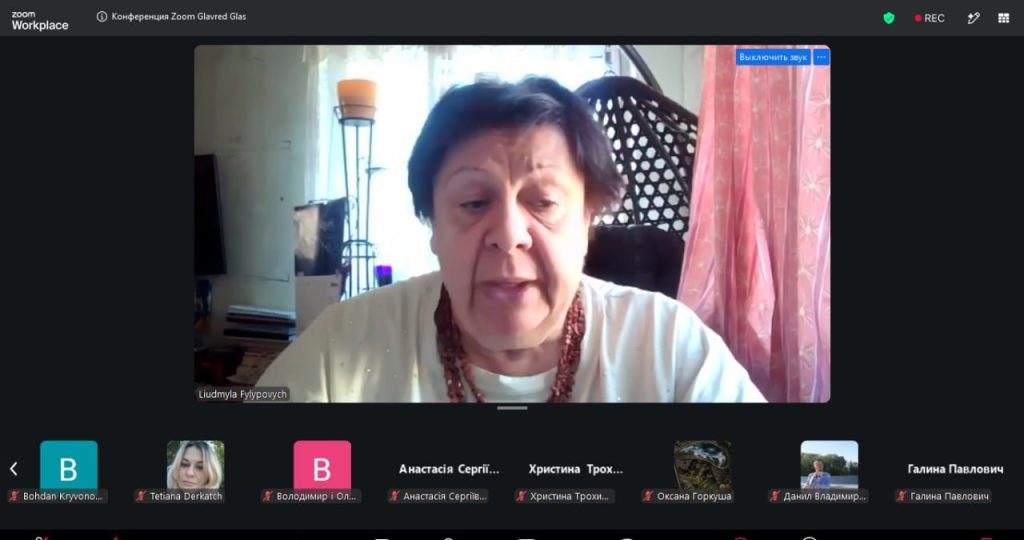
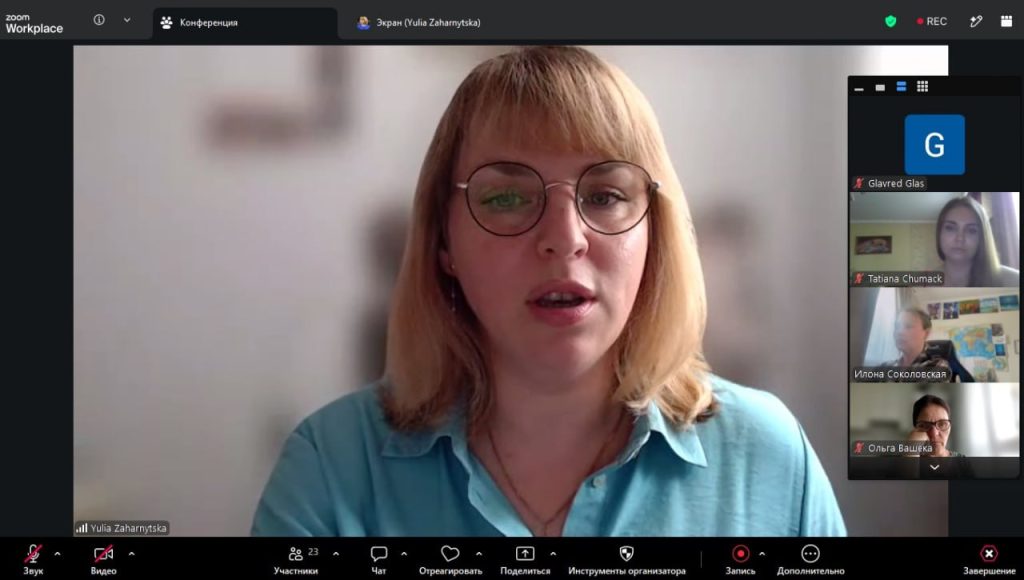
These were the questions discussed by participants in another webinar of the “Youth for the Future of Ukraine” project with Yuliia Zaharnytska, a psychologist at the Mental Health Center of the National University of Kyiv-Mohyla Academy, a CETA counsellor, trainer, and supervisor in the CETA CPSS programme.
This conversation was not so much about diagnoses as it was about the ability of individuals – and society – to remain alive when reality offers no sense of safety for a prolonged period.
Not Every Traumatic Event Becomes Psychological Trauma
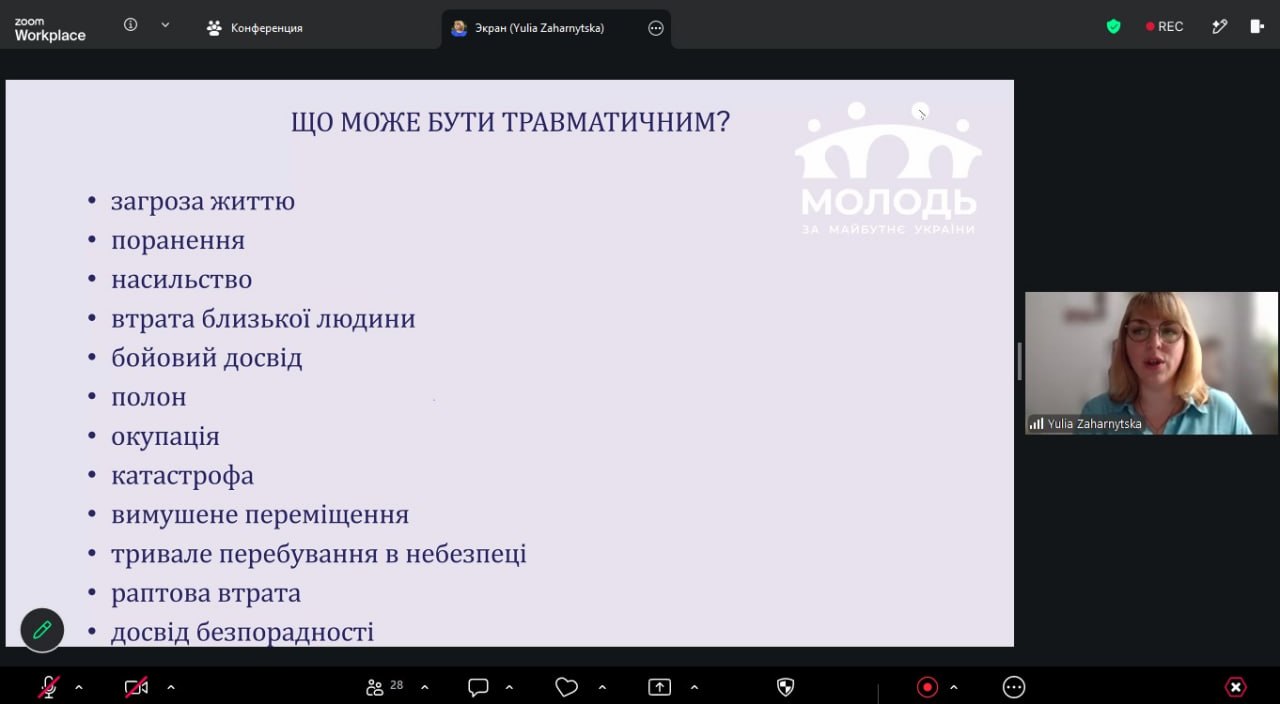
One of the most important points with which the conversation began was the need to distinguish between a traumatic event and psychological trauma.
An explosion, shelling, occupation, or the injury of a loved one – these are events. But trauma is not the event itself. It is how an individual psyche experienced that event and what happened to the person afterwards.
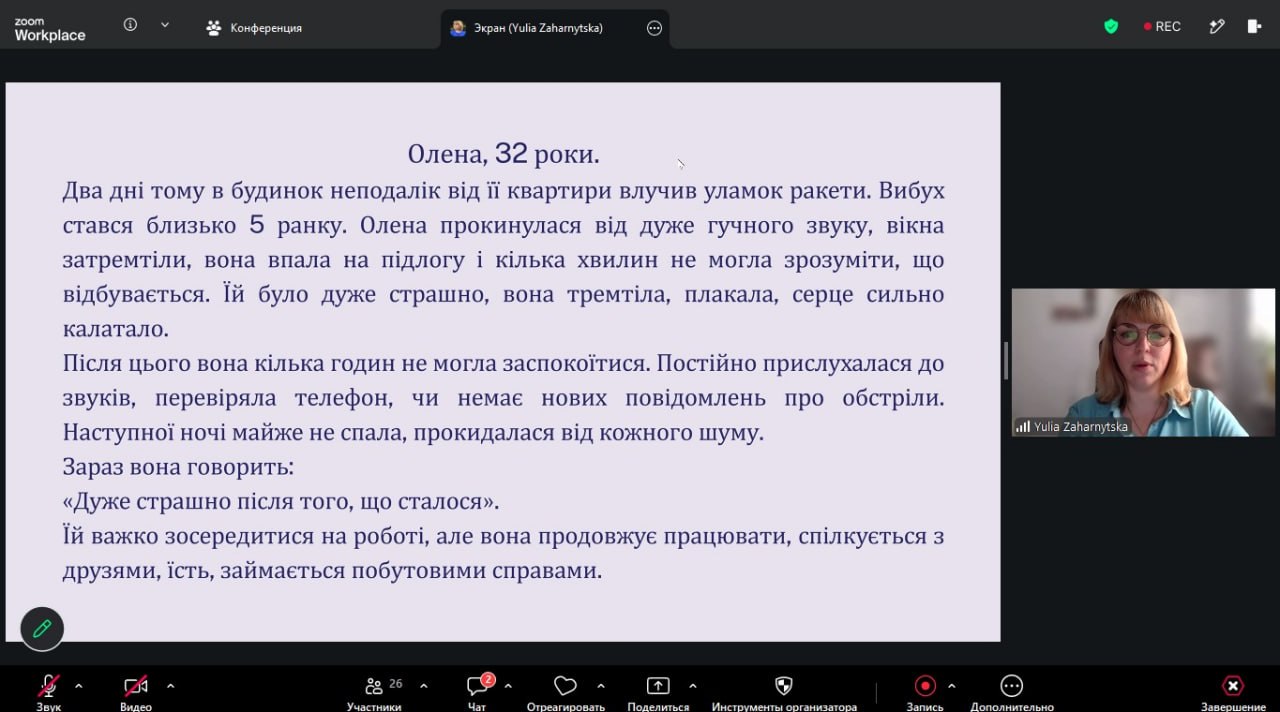
That is why two people can experience the same shelling and yet face completely different consequences. One may gradually return to ordinary life, while the other may continue to startle at sudden sounds for years. “A normal reaction to abnormal circumstances” – this is how many acute reactions following a dangerous event can be described. Trembling, rapid heartbeat, crying, insomnia, intense agitation, inability to concentrate, constantly listening for sounds – in themselves, these do not necessarily indicate a mental disorder. The body mobilises in order to survive. The problem begins when this system does not switch off after the danger has passed, or when the symptoms become prolonged and begin to shape a person’s life.
Stress Is Not Always the Enemy
In everyday language, we are accustomed to speaking about stress as something unequivocally negative. But, as Yuliia Zaharnytska explained, stress itself is primarily the body’s response to change.
It can mobilise us. A student feels anxious before an exam – and this can help them focus, recall what they have learned, and become more attentive. But if the tension becomes excessive, memory may actually function less effectively. The same is true during wartime.
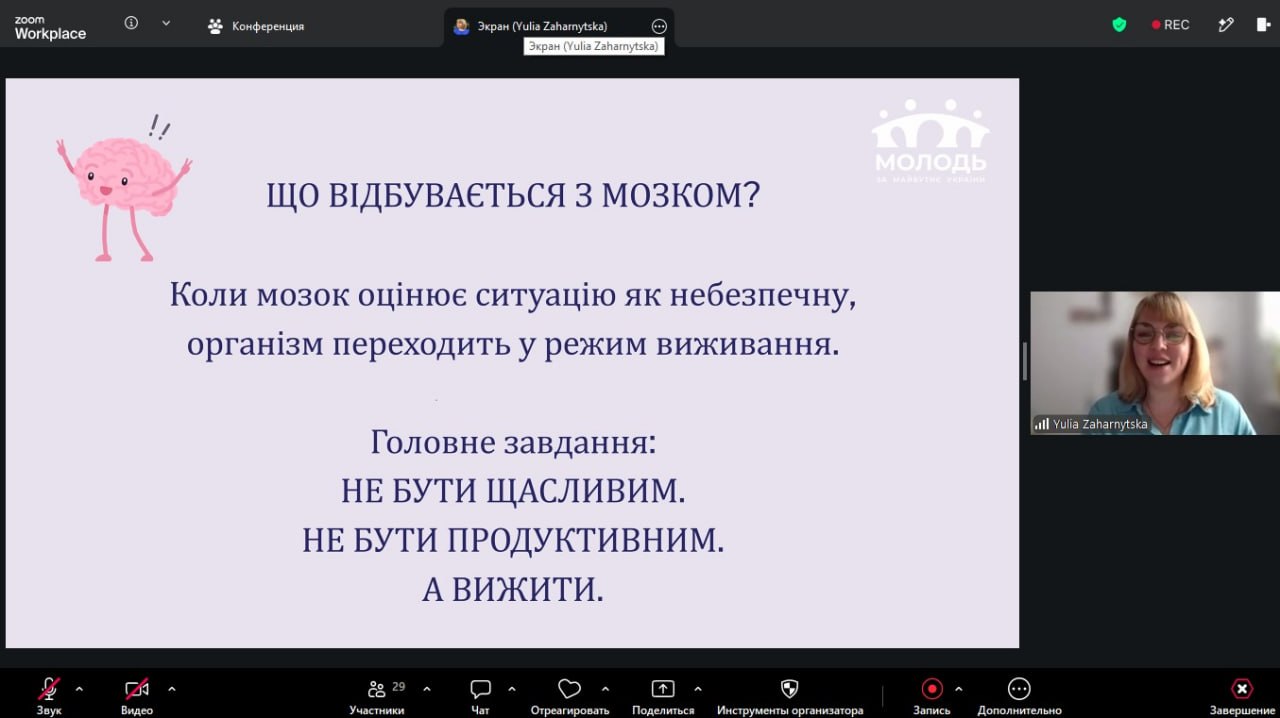
When the brain perceives an immediate threat, it narrows its focus to the primary task – survival. At that moment, long-term planning, learning languages, or professional development are simply not priorities.
This is why, after the first months of the full-scale war, many Ukrainians who had gone abroad suddenly found that they could not study or work normally or retain new information. This did not necessarily mean that a person had “become less intelligent”. Their brain was simply operating in a different mode.
If stress is too intense, lasts too long, and there are insufficient resources for recovery, mobilisation turns into distress – a state that begins to cause harm.
When the Past Becomes the Present
One of the cases discussed during the webinar concerned Maryna, who, a year and a half ago, provided assistance to a severely wounded man during a massive attack. He survived. But for Maryna, the event did not end. She regularly has nightmares in which she relives that day. The smell of smoke or a sudden sound triggers a racing heartbeat, trembling, and nausea. She avoids the news and crowded places and constantly calls her husband to make sure that he is all right. This is no longer simply fear.
When a traumatic memory does not seem to receive a clear marker saying “that happened then”, a person may experience the past as something happening here and now. A flashback is not simply a memory.
It is a moment when a trigger – a sound, smell, image, or situation – can provoke such an intense reaction that the body behaves as though the danger has returned. This leads to avoidance. A person stops walking along certain streets, watching the news, driving, going to crowded places, or talking about what happened. Hyperarousal can also emerge: constant vigilance, a need for control, irritability, and problems with sleep and concentration. This is why PTSD is not simply “intense fear”. It is a condition in which traumatic experience begins to structure a person’s life for them.
PTSD Is Not About Weakness of Character
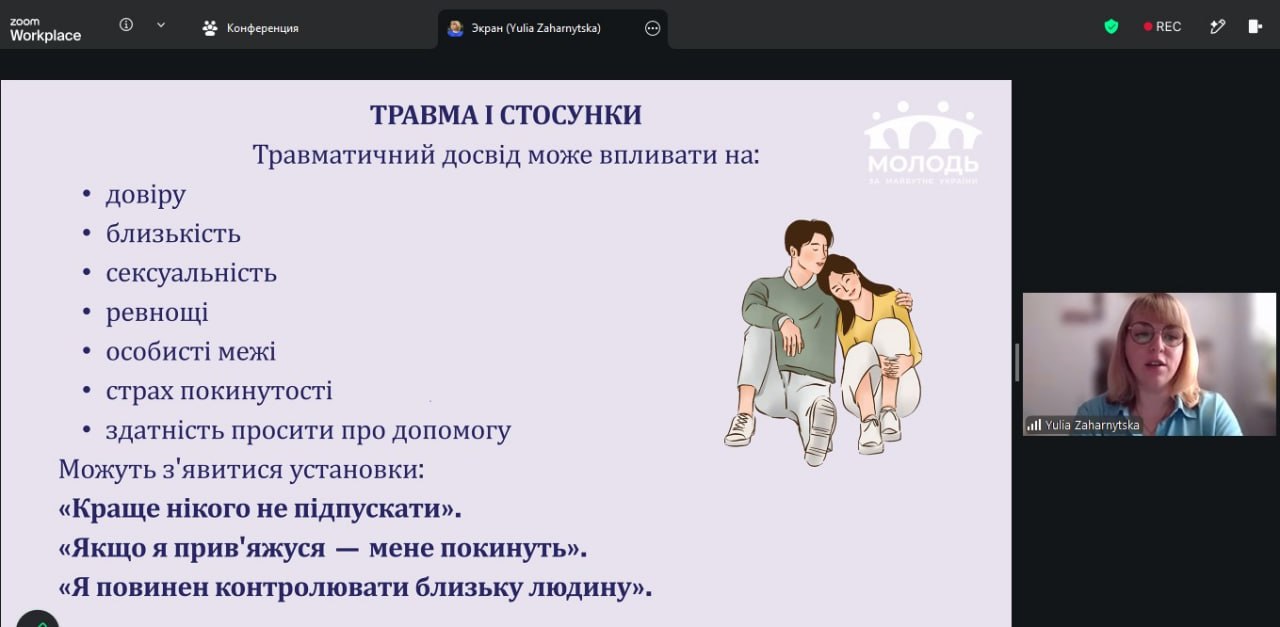
Yuliia Zaharnytska also emphasised a dangerous myth: that a person should have enough willpower to “get over” trauma on their own. This is not the case. The psyche is not a mechanism that can be controlled by a single decision. After a traumatic event, a person’s attitudes towards themselves, others, and the world may change. The world may begin to seem dangerous. Other people may seem unreliable. And the person may decide that they now have to control absolutely everything. In this way, traumatic experience can penetrate even the closest relationships.
For example, after a child is involved in a road accident, a mother may become so afraid that the tragedy could happen again that she begins controlling every step of the child even after they have recovered. For her, this is a way of protecting someone she loves. For the child, it means a gradual loss of freedom.
Trauma changes more than how a person feels. It can change patterns of behaviour.
This is why seeking professional help is not a sign of defeat.
Sometimes, in order to stop living according to the rules imposed by trauma, we need another person who can help us see what is extraordinarily difficult to perceive from within our own experience.
Not Everything Should Be Called PTSD
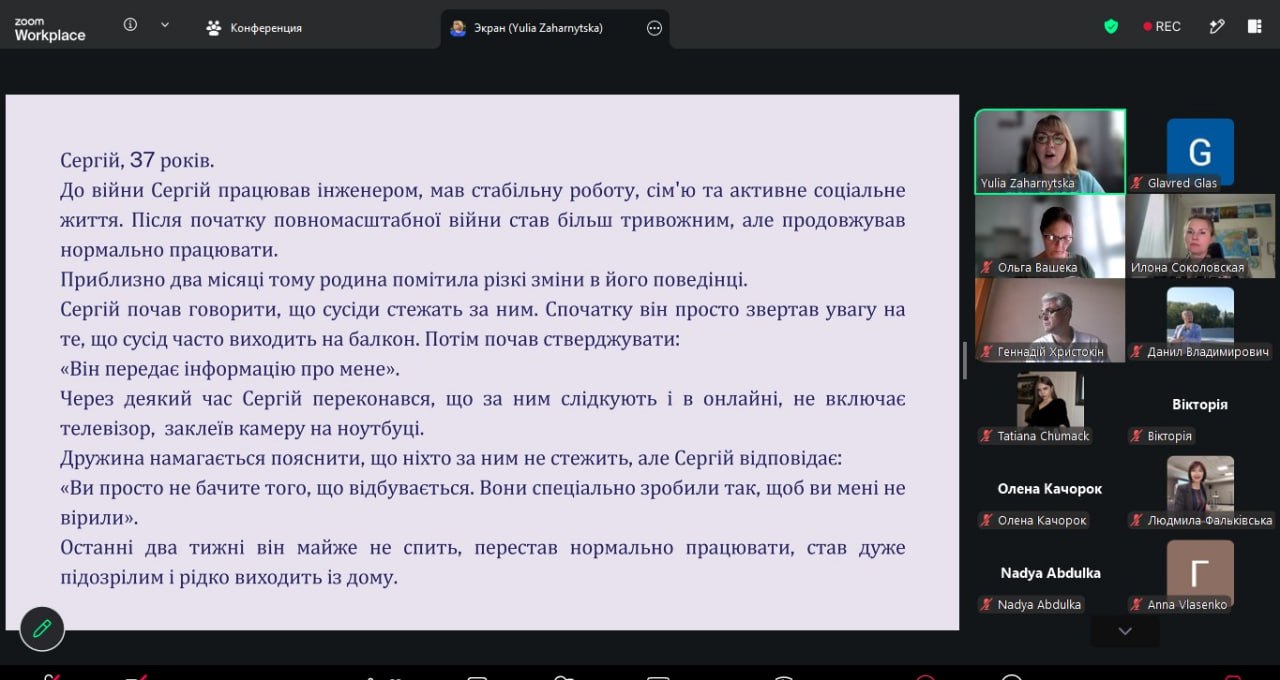
At the same time, another important warning emerged during the discussion: we should not diagnose ourselves or others on the basis of just a few symptoms. Suspiciousness, anxiety, insomnia, aggression, or avoidance can arise for many different reasons. One of the cases presented concerned Serhii, who, after prolonged stress, became convinced that his neighbours were watching him and passing on information about him, and that he was also being monitored online. He covered his laptop camera, barely slept, was no longer able to work normally, and became increasingly isolated. This is no longer a situation that should simply be explained as “war trauma”.
Symptoms like these require a professional medical assessment, not an informal diagnosis from relatives or friends.
It is equally dangerous to underestimate problems related to alcohol. In another case, Vitalik began drinking alcohol almost every day after the death of a close friend, explaining: “After two or three drinks, I finally stop thinking.” When he does not drink, he experiences trembling, anxiety, insomnia, and irritability. Alcohol is no longer a way to relax but a means of regulating his psychological state. At this point, another problem is developing – dependence. In both cases, the central principle is the same: we should not try to explain everything with the single word “trauma”.
Ukraine: When the Danger Does Not End
A particularly important part of the discussion in the context of the Ukrainian experience concerned the fact that we are living through an event that has not yet ended. A veteran returning from the combat zone in 2016, for example, was returning to an environment that was relatively safe. The psyche received a signal: the danger was over. Today, the situation is different. Millions of Ukrainians have spent years living in an environment where danger can return on any given night. We have adapted. We keep power banks charged and maintain supplies of water, medicine, and food. We know where the shelters are. We respond to air-raid sirens. We know how to check information about threats.
This does not necessarily mean that we are living in a state of pathological fear. On the contrary, in conditions of real danger, some of these actions are rational forms of adaptation. But this adaptation comes at a cost. It is difficult for the brain to make long-term plans when the foundations of life remain unstable.
A House That First Needs a Foundation
One of the most striking metaphors from the webinar was that of a house. Its foundation consists of safety and basic needs: sleep, food, warmth, housing, financial stability, physical safety, and social support. Only on the higher floors do we find education, career, self-development, creativity, spirituality, and long-term planning. We often expect ourselves to continue developing even during wartime as though nothing were happening.
To enter university. Learn languages. Build a career. Start a business. Create a family. Decide where we want to live ten years from now.
But if a person does not know whether there will be an attack during the night, or whether they will have a home, a job, or money tomorrow, it is entirely natural for their psyche to concentrate on the foundations.
That is why taking care of basic needs is not an “everyday triviality”. It is one of the prerequisites for psychological resilience.
Trauma Can Change Even the Way We Imagine the Future
There is another consequence of living in prolonged danger that is especially important for young people.
The loss of the ability to see the future.
When tomorrow seems unpredictable, long-term planning can begin to feel almost meaningless. Why go to university? Why build a career? Why start a family? Why plan a life in Ukraine if everything could change overnight? This can create an attitude of living only for today. But the ability to envision the future can be restored. And here, it is important not to demand grand plans from ourselves. Sometimes reclaiming the future begins with much simpler questions:
What do I want to preserve within myself? What do I want to learn? What do I definitely want to carry from my experience into the future?
This is already a restoration of agency. We often have no control over what the world will be like.
But what I do with my experience is, at least partly, up to me.
War Traumatises More Than Individuals
When traumatic experience becomes widespread, it is no longer only individual psychology that changes. Society itself may change. Collective trauma influences how a community perceives itself, others, and its own future. This is already visible in Ukraine. A particular concern with safety. Supplies of water, food, and medicine. A culture of donating. Mutual assistance. Attitudes towards military personnel. New rituals of remembrance. The minute of silence at nine o’clock. New symbols. The strengthening of civil society. These are different ways in which the war is already transforming Ukrainian culture.
And these changes will not necessarily be only negative.
Collective trauma can transmit to future generations not only fear and pain, but also ways of recovering, solidarity, a readiness to help, and the capacity for self-organisation.
The question is what exactly we will pass on.
Trauma Will Not Automatically Disappear After the War
The end of the war will not automatically mean the end of its psychological consequences. On the contrary, for many people, the process of understanding what has happened to them may begin only after the immediate danger has passed. And here Ukraine will have to address more than individual cases of PTSD. We will need to work with trust, memory, loss, the return of veterans, families, young people, social conflicts, and different experiences of war. One Ukrainian may have experienced occupation, another evacuation, a third the front line, a fourth the loss of a loved one, a fifth life in the rear under missile and drone attacks, while a sixth may have spent several years abroad. All these experiences are different.
And this is where a question arises that extends far beyond psychology.
Will we be able to learn not to weigh other people’s pain on a scale?
Not to decide who “had it worse”. Not to say, “Others have had it even worse.” Not to demand that a person forget something that was important to them. Not to turn different experiences into yet another reason for hostility.
A Culture of Listening as a Tool for Social Recovery
One of the most important ideas raised during the discussion was not really about psychology as such, but about our culture of communication. We often find it very difficult to bear witness to another person’s pain. So when someone says, “I’m really struggling”, instead of simply hearing them, we begin offering advice. “Pull yourself together.” “Time heals.” “Others have it worse.” “You should do this.” “You should go there.” Sometimes, behind this compulsive need to “fix” something lies our own inability simply to remain present with another person’s pain.
But support can begin much more simply.
“I can see that this is difficult for you.”
“This really hurts.”
“I’m here.”
“What do you need right now?”
This does not solve the problem. But it restores a person’s sense that their experience has been seen and acknowledged.
And here, a psychological skill suddenly becomes a social one. Because social trust also begins with the ability to hear someone whose experience differs from our own. Perhaps after the war Ukraine will need not only a culture of psychological support, but also a culture of listening and of speaking in ways that do not cause further trauma.
A Point We Did Not Choose
At the end of the webinar, Yuliia Zaharnytska offered participants a simple but very powerful exercise:
What do I want to preserve within myself?
What do I want to learn?
What do I definitely want to take with me into my future?
These questions matter precisely because they do not deny traumatic experience.
We did not choose the war. We did not choose missile strikes. We did not choose our losses.
We did not choose much of what has happened to us. But gradually, we can reclaim the right to determine what comes next. The goal of working with trauma is not to erase the past. It is to ensure that the past no longer controls our present. And perhaps this applies not only to individuals.
Ukraine, too, has already reached a point it did not choose.
But what our story will look like after this point depends to a great extent on what we decide to preserve, what we learn, and what we take with us into the future.
Traumatic experience can be part of our story. But it does not have to become our entire story.
The webinar “Psychological Trauma and Its Consequences for the Individual and Society” took place as part of the “Youth for the Future of Ukraine” project, implemented with the support of the German Government (zivik/ifa) – a series of educational meetings aimed at fostering dialogue, critical thinking, mutual understanding, and social resilience among young people.