
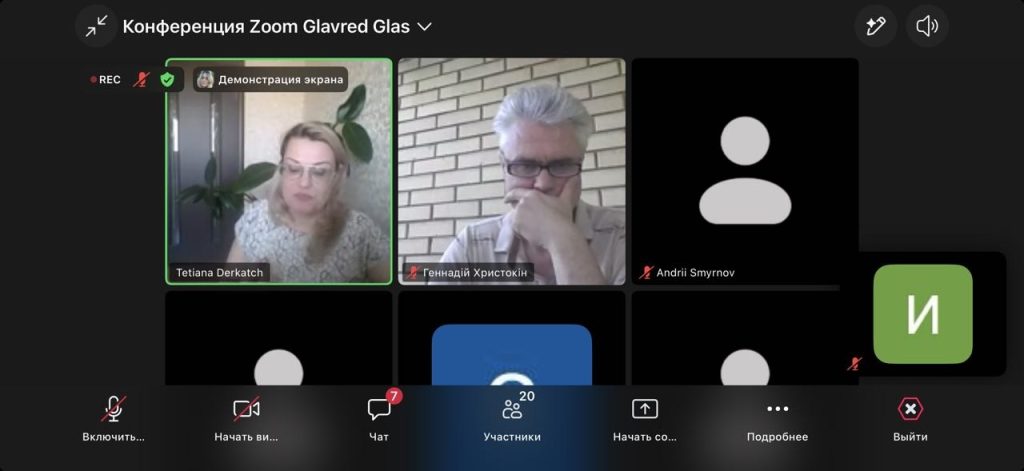
As part of the project “Youth for the Future of Ukraine: Dialogue, Research, and Creative Media Work for the Consolidation of Ukrainian Society and Orthodoxy,” another webinar was held within the ongoing series dedicated to the common good and the reconstruction of Ukraine.
The guest speaker was Tetiana Derkach, a religious journalist, researcher of contemporary church affairs, and author of the book The Moscow Patriarchate in Ukraine: The Anatomy of Betrayal. She presented the topic “Church Polarization and Its Impact on the Common Good,” inviting participants to view the church conflict not merely as an internal issue of Orthodoxy but as a phenomenon that affects Ukrainian society as a whole.
The webinar focused not on determining which side of the conflict is right, but on examining what decades of church confrontation have done to social trust. Participants traced how, over more than three decades, the original dispute over canonical status gradually accumulated additional layers involving identity, politics, security, war, legitimacy, and collective trauma, transforming the church conflict into a complex societal issue.
Particular attention was devoted to the ways in which the church conflict reinforces existing forms of polarization. The discussion explored the relationship between military personnel and the civilian rear, between Ukrainians living in Ukraine and those living abroad, political polarization, linguistic and cultural divisions, as well as the fundamental question of what model of state Ukraine is seeking to build after the war. The church factor was presented as a catalyst that does not create new divisions but has the capacity to intensify existing social tensions.
A separate section of the webinar focused on social trust. Drawing upon the ideas of Niklas Luhmann, Robert Putnam, Francis Fukuyama, and Max Weber, the speaker demonstrated that trust is not merely a moral virtue but a fundamental resource of the modern state. It reduces social costs, enables people to cooperate beyond the boundaries of their own “bubbles,” contributes to economic development, and provides legitimacy to state institutions.
The central conclusion of the discussion was that the consequences of the church conflict cannot be assessed solely by the number of parishes or changes in ecclesiastical jurisdiction. Far more important is its impact on the ability of Ukrainian society to trust one another, cooperate, and work together for a shared future. For this reason, the proper measure of the conflict is not church statistics but the level of social trust and society’s capacity for cooperation.
As is customary, the webinar concluded with a lively discussion. Young participants jointly reflected on challenging questions: after the war, what will matter more for Ukraine—the fullest possible restoration of justice or the preservation of social unity? Is it possible to reconcile these two objectives? And what role should the Church play in rebuilding trust between people?
It is precisely these kinds of conversations that help cultivate a culture of dialogue and a responsible search for solutions—without which the future of a democratic Ukraine is impossible.