

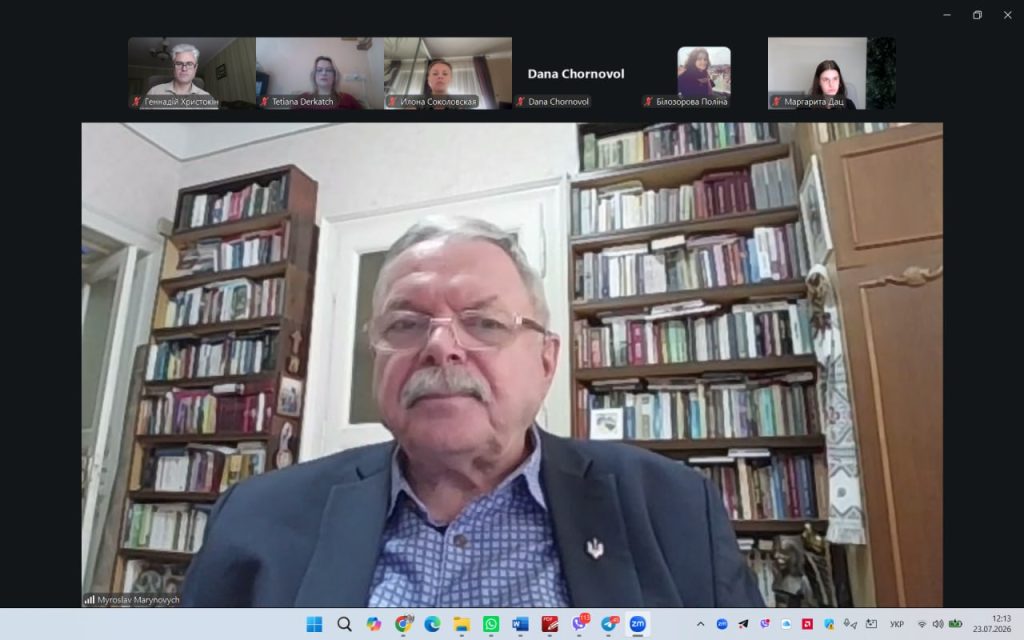
As part of the project “Youth for the Future of Ukraine: Dialogue, Research, and Creative Media Work for the Consolidation of Ukrainian Society and Orthodoxy,” another webinar was held to seek answers to questions on which the country’s future already depends today. The guest speaker for the young participants was one of the most authoritative moral leaders of contemporary Ukraine: Ukrainian human rights defender and dissident, co-founder of the Ukrainian Helsinki Group, former political prisoner of the Soviet camps, Honorary President of Ukrainian PEN, and long-serving Vice-Rector of the Ukrainian Catholic University, Myroslav Marynovych.
Despite the announced topic, “Leadership and the Source of Strength,” the conversation quickly went far beyond a traditional lecture on leadership qualities. It became an open dialogue about freedom, responsibility, sacrifice, trust, and the moral choices a person must make in times of historic upheaval.
Leadership Begins Where a Person Does Not Betray Themselves
Drawing on his own life, Myroslav Marynovych showed that genuine leadership does not arise from high office or formal authority. It is born at the moment when a person consciously chooses to remain faithful to their values, even when that choice involves loss, persecution, or personal danger.
Recalling the years of his Soviet imprisonment, he spoke not only about physical hardship, but also about the inner freedom that enables a person not to submit to evil. In his words, evil may win individual battles, but it cannot ultimately prevail as long as people remain faithful to the good.
The speaker devoted particular attention to voluntary sacrifice. In his view, it is a voluntary choice that gives suffering meaning, whereas sacrifice imposed by force becomes destructive to the human person. At the same time, he described the most difficult moral trial not as one’s own suffering, but as the pain of loved ones who are also forced to bear the consequences of a person’s choice.
Trust as the Main Point of Support
Trust became one of the central themes of the meeting. Myroslav Marynovych acknowledged that during the most difficult years of imprisonment, he was sustained not only by faith, but also by an awareness of his responsibility toward the people who trusted him.
His friends, like-minded companions, and family became the “Archimedean point of support” that prevented him from breaking even when the door of the prison camp cell closed behind him.
This idea became the starting point for a lively discussion about contemporary Ukraine. The young participants spoke about the crisis of public trust, which is becoming increasingly evident in relations among individuals, communities, and institutions. Together with the speaker, they sought an answer to the question of how society can regain the ability to trust and why neither responsible leadership nor a strong state is possible without it.
Ukraine Is Not Unison, but a Choir
Myroslav Marynovych’s reflections on Ukrainian identity generated particular interest.
In his view, Ukraine is, by its very nature, a mosaic state. Attempts to make it uniform are doomed to failure because the strength of Ukrainian society lies precisely in the ability of different regions, cultural traditions, and experiences to coexist without losing their distinctiveness.
The most vivid illustration of this idea was the metaphor of a Ukrainian choir.
According to the speaker, a true choir does not sing in unison. It sounds beautiful because different voices perform different parts while remaining in the same key. In his view, Ukraine should remain the same: united in its fundamental values, yet open to internal diversity.
Young People Asked About the Future
A significant part of the webinar took the form of an open discussion.
The young participants asked questions not only about the history of the dissident movement, but also about the challenges they themselves will have to face after the war. They spoke about the crisis of trust in Ukrainian society, the moral dilemmas of contemporary leaders, responsibility toward family and country, the need for strong institutions, and how to raise a generation capable of taking responsibility not only for personal success, but also for the common good.
Particular attention was given to the criteria by which a modern person’s success is measured. While young people today often assess success in terms of career, influence, or material prosperity, Myroslav Marynovych offered an entirely different perspective. He described the main outcome of his life not as professional achievement or public recognition, but as the inner path he travelled during his years of imprisonment, which, in his words, became the true birth of a new person.
From Heroism to Responsible Institutions
During the discussion, participants addressed another fundamental theme: the future of Ukrainian leadership.
They spoke about how, after the war, heroes alone will not be enough for Ukraine. The country will need leaders capable of building institutions founded on trust, responsibility, and service to the common good. Such people will be able to secure the state’s development when the period of extraordinary challenges comes to an end and the time for systematic work begins.
For this reason, the conversation about the moral choice of an individual unexpectedly developed into a discussion about the future model of the Ukrainian state.
A Space Where Responsible Leaders Are Formed
The webinar with Myroslav Marynovych once again confirmed the central idea of the “Youth for the Future of Ukraine” project: young people need not only knowledge, but also encounters with people whose personal experience serves as an example of moral responsibility.
The purpose of these meetings is not to offer ready-made answers to difficult questions, but to help form a generation of Ukrainians capable of critical thinking, honest dialogue, responsibility for their decisions, and building the country’s future on the foundations of freedom, trust, and human dignity.
Such conversations help young people understand that genuine leadership does not begin with power. It begins with a person who, regardless of the circumstances, does not betray their values.