
Greetings, everyone. My name is Tetiana Derkach. I am a religious journalist who has been studying the Ukrainian church conflict for nearly twenty years. At one time, I was an active participant in this conflict on one of its sides. In other words, I was deeply immersed in the public debates surrounding it. I wrote dozens of articles on the subject and even published a book. However, after some time, I began to feel increasingly uncomfortable with the position I occupied, and this marked the beginning of my own journey of transformation and reflection. The church issue gradually moved beyond the sphere of public discussion into the realm of harsh physical confrontations. At that point, I decided to “leave the chat,” though not to delete the entire crazy TikTok feed, so to speak. Today, I am trying to look at church polarization neither from the sidelines nor from above, but simply from a different reality. In particular, I want to examine it through the lens of the humanities – disciplines that churches themselves often study only rarely because of certain reservations. The basic idea is this: if we remove from the conflict its highly specific, almost bird-like ecclesiastical language of piety, then the actions, motivations, intentions, and arguments of its participants begin to look rather different.
Every webinar is an author’s presentation of their own position, research, and conclusions. Therefore, this webinar presents my own perspective on the problem – a perspective that has been hard-earned. At the same time, it includes an interactive component. All participants will be invited to join the discussion. Here is what I propose: I will present several key thematic blocks as I see them, and after each one I will pose questions both to church-affiliated young people and to secular youth. In this way, I hope to test my own conclusions against your comments and observations.
Why have I chosen this mixed format, bringing together secular and church youth? Because sometimes it is helpful to step outside one’s own bubble – and religious life is almost always a bubble – and hear how all of this appears from the outside. The perspective of secular young people on religious issues is extremely important because, in our secular society, the public often becomes an indirect participant in religious conflicts by acting as a kind of judge through public opinion surveys. Those surveys, in turn, influence various actors and stakeholders, to use today’s fashionable terminology.
So, I would like to begin with one observation. The conflict within Ukrainian Orthodoxy has long ceased to be only about the Church. It is no longer merely an internal ecclesiastical matter. Gradually, it has become part of broader processes taking place throughout Ukrainian society. It affects not only church life but also the level of trust between people, local communities, attitudes toward the state, political debates, national security, even people’s economic behavior, and ultimately the way we perceive one another as citizens of the same country.
That is precisely why today we have both church-affiliated young people and people who may not even consider themselves religious. The issue we will discuss is much broader than questions of canonical status or ecclesiastical jurisdiction. In other words, we will examine this conflict not in isolation but within the broader context of the country as a whole – its resilience, its defense capability, its capacity for survival, and much more.
We will discuss how a decades-long church conflict affects the ability of Ukrainian society to remain united, and how it has become part of a much larger system of social divisions within Ukraine.
Block 1. The Nodes of Conflict Accumulation
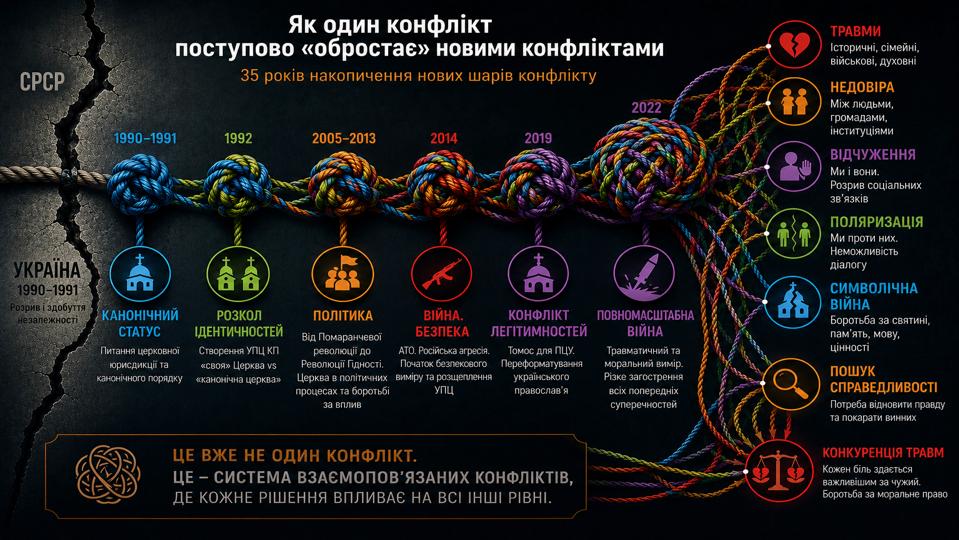
To illustrate this, I prepared (or rather, artificial intelligence prepared) the following image.
Let us take one small step back.
In 1991, Ukraine became an independent state. Along with the severing of its political ties to the Soviet Union, a new question emerged: what should the Ukrainian Orthodox Church be like? This marked the appearance of the first node of conflict – the question of canonical status.
At first glance, this appeared to be a purely ecclesiastical issue. However, it very quickly ceased to be only that. Moscow began to resist these developments, leading to the establishment of the Ukrainian Orthodox Church–Kyiv Patriarchate in 1992. This launched a new dimension of the conflict – the split of identities. For some people, the idea of having an independent Ukrainian Church became paramount. For others, preserving canonical continuity remained the highest priority. Gradually, people began to answer differently not only the question, “Which Church is the correct one?” but also, “Who are we as Orthodox Ukrainians?”
Politics was then added to the equation – or, more precisely, what we now call a “civilizational choice.” The period stretching from the Orange Revolution to the Revolution of Dignity further politicized the church environment. Churches increasingly came to be perceived not merely as religious institutions but also as participants in social and political processes.
After 2014, war began. With it emerged yet another dimension – that of security. Society increasingly began asking questions not only about canonical legitimacy or historical continuity but also about risks to national security. Within the Ukrainian Orthodox Church itself, difficult processes of rethinking its own identity also began.
In 2019, the Orthodox Church of Ukraine (OCU) was established, launching a new phase of restructuring Ukrainian Orthodoxy. A new question arose – that of ecclesiastical legitimacy: who has the right to represent Ukrainian Orthodoxy?
Russia’s full-scale invasion in 2022 made the situation even more complex. The war dramatically intensified all the previous contradictions while simultaneously adding another extremely powerful factor – collective trauma.
If we look carefully at this diagram, we can observe one clear pattern. Each new stage did not replace the previous one. The canonical conflict did not disappear when the political conflict emerged. The political conflict did not disappear after the outbreak of war. The security dimension did not erase the historical disputes. Instead, each new layer was simply added on top of those that already existed.
Evolution of the Subject of the Conflict
1990–1991 — Canonical Status (Who are we?)
1992 — Identity Split (Whom do we belong with?)
2005–2013 — Politics (Whose side are we on?)
2014 — War and Security (Do we—or someone else—pose a risk to the state? Who does not belong?)
2019 — Legitimacy (Who has the right to represent Ukrainian Orthodoxy?)
2022 — Collective Trauma (How has the war transformed all participants in the conflict?)
This is why today we are no longer dealing with a single conflict but with a highly complex system of interconnected conflicts within Orthodoxy.
Moreover, this internal conflict is itself intertwined with broader societal debates:
- historical;
- political;
- security-related;
- legal;
- symbolic;
- psychological;
- cultural;
- media-related;
- international (diplomatic).
Let us pause here and recognize one important conclusion. We are no longer dealing with an isolated problem but with an entire system of interconnected problems. The next question naturally follows: If the conflict has become systemic, what is its principal impact on the country as a whole? In my view, the answer is the gradual erosion of social trust. That is precisely what I propose we discuss next.
Church polarization is not the direct cause of other social divisions. However, I am deeply convinced that it serves as an amplifier and legitimizer of already existing tensions. It provides them with:
- a language;
- moral justification;
- and an institutional infrastructure through which they can reproduce themselves (parishes, media outlets, and the pulpit).
By undermining trust, it ultimately strikes not at the churches themselves but at the very capacity of the state and society to function.
Block 2. The Key Polarizations Reinforced by the Church Conflict
Let us take the research conducted by OPORA as our starting point.
1. Military Personnel ↔ Civilians (“the Rear”)
On the one hand, we can see that mutual misunderstanding is beginning to accumulate between military personnel and civilians. Some members of the military speak about a sense of injustice, insufficient recognition of their sacrifice, and the fear of being forgotten after the war. Some civilians, in turn, feel exhausted by the war, experience tension because of mobilization, and increasingly distance themselves from the front.
How does the church conflict reinforce this polarization? For many military personnel, the question of church affiliation has long ceased to be a theological one. It is perceived primarily through the lens of security and personal combat experience. Some members of the military have directly encountered, in frontline or de-occupied territories, cases in which individual clergy of the Ukrainian Orthodox Church were convicted or suspected of cooperating with the occupation forces or spreading pro-Russian propaganda. Regardless of how representative these cases are of the Church as a whole – and the leadership of the Ukrainian Orthodox Church insists that they are not – they shape a generalized perception of the institution as a potential security risk.
Therefore, for a member of the military, the question is no longer phrased as follows: “What is the canonical status of this Church?” Instead, it sounds entirely different: “Can I trust an institution that operates in my rear?”
Trust in the rear is one of the fundamental categories of military culture. If there is suspicion that the rear may be disloyal or internally divided, this directly affects the morale of those who are fighting.
Why does this reinforce polarization? The problem lies not only in individual cases of collaborationism but also in how the institution responds to them. If society does not see a clear and convincing internal response to such cases, the impression arises that the institution is unable to draw an understandable line between its own religious identity and the unacceptable conduct of some of its representatives. At that point, the Church ceases to be an external observer of “earthly affairs.”
It is precisely this social perception that becomes a catalyst for distrust.
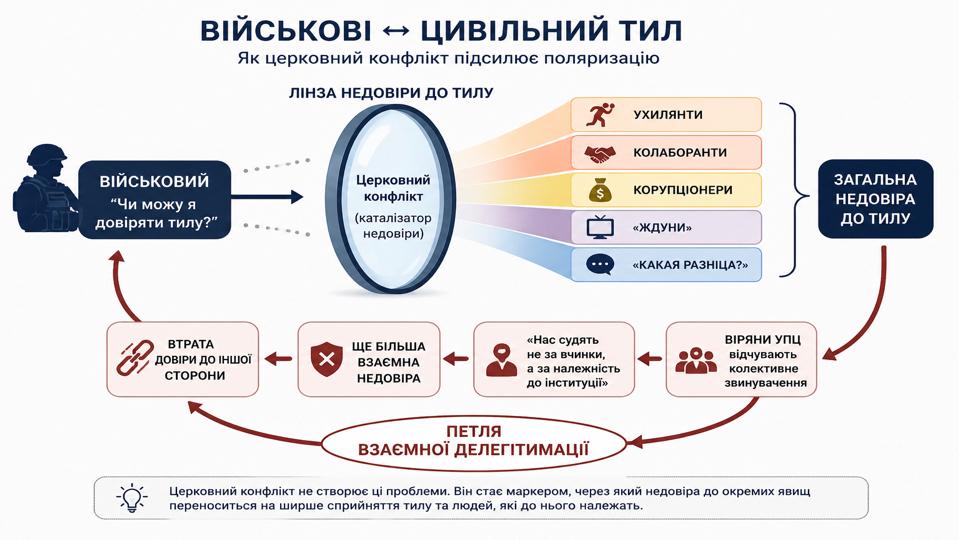
There is also another dimension: thousands of believers of the Ukrainian Orthodox Church are fighting at the front, and they have their own perspective on what is happening in the rear, where communities – or, more precisely, church buildings – are being transferred by force. The following thought emerges: “While we are here fighting for the state, the state is facilitating the destruction of my Church.” For a believer, church identity is often more important than national, political, or state identity.
What happens next? A kind of loop of mutual delegitimization is set in motion.
Distrust toward individual representatives is transferred to the entire church community. In public discussion, an implicit logic increasingly emerges: if your institution has failed to distance itself clearly from disloyal representatives, then its moral right to speak about its own losses, pain, or injustice is also called into question.
This creates a hierarchy of suffering: some victims of the war are recognized as more “genuine” than others. In response, believers of the Ukrainian Orthodox Church develop a stronger sense of collective punishment. They perceive themselves as people who are being judged not for their personal actions but for their affiliation with a particular institution. This further deepens mutual distrust.
As a result, the church conflict ceases to be merely a dispute between two jurisdictions. It begins to influence whom we are prepared to trust in society, whose pain we recognize as genuine, and whom we consider morally legitimate. This is precisely how it becomes a catalyst for broader social polarization between “the front” and “the rear.”
2. Internally Displaced Persons ↔ Host Communities
One of the most visible polarizations discussed in OPORA’s research is the tension between internally displaced persons and host communities. Over time, the initial wave of sympathy is increasingly being replaced by mutual grievances, fatigue, distrust, and a sense of injustice. Displaced persons often feel that they are treated as “outsiders,” while local communities feel that they are the ones bearing the main burden of the war.
How does the church conflict reinforce this polarization? Relocation itself already makes a person the bearer of certain stereotypes. But the church conflict adds another marker – confessional geography. If a region is associated with a large number of communities of the Ukrainian Orthodox Church, then along with the territory, a person may also inherit a certain reputation, even if that person has never personally been involved in church life or belongs to another denomination. In other words, it is no longer the particular individual who is being evaluated, but rather the image of the region from which that person has arrived.
As a result, the church conflict gives additional moral content to already existing territorial stereotypes. The question “Where are you from?” imperceptibly turns into the question “To what extent are you one of us?”
Even though this logic is almost never expressed directly, it is precisely this logic that can imperceptibly increase the distance between displaced persons and host communities. Parishes of the Ukrainian Orthodox Church of the Moscow Patriarchate predominate in some frontline and de-occupied regions. Displaced persons from those areas automatically come under suspicion regarding their loyalty – not because of their own actions, but because of the confessional “registration” of the community from which they have fled. Here, the church conflict provides a ready-made language of suspicion – “from a place where the Ukrainian Orthodox Church of the Moscow Patriarchate is dominant” – for an already tense process of accepting internally displaced persons.
3. Ukrainians in Ukraine ↔ Ukrainians Abroad
After the beginning of the full-scale war, tension also began to accumulate between Ukrainians who remained in the country and those who left for other countries. Some people in Ukraine believe that emigrants are gradually losing touch with the reality of the war, while many Ukrainians abroad feel that their contribution to supporting Ukraine is underestimated or completely overlooked.
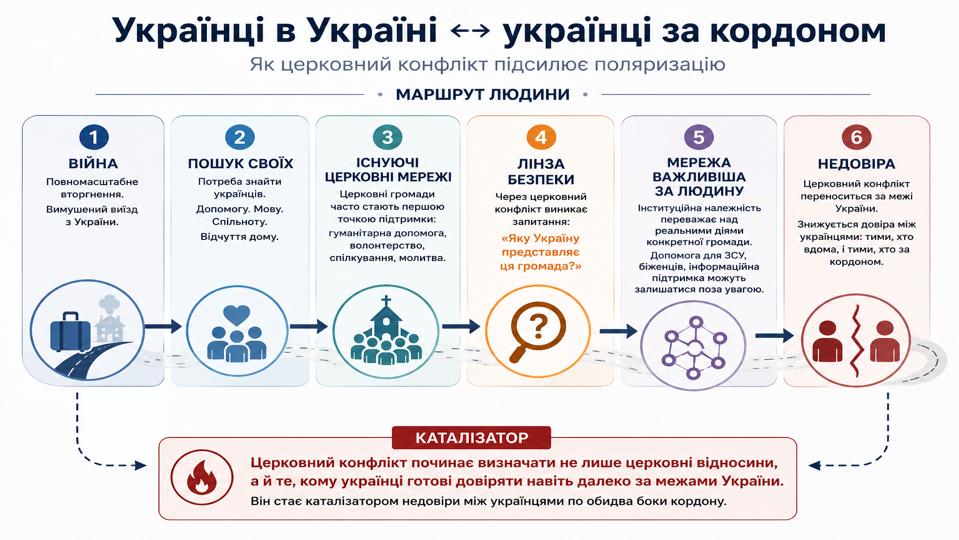
How does the church conflict reinforce this polarization? For millions of Ukrainians who left the country after 2022, church communities became some of the first places where they could find support, humanitarian assistance, communication in the Ukrainian language, and a sense of community.
Historically, however, a significant part of this infrastructure abroad already existed in the form of parishes of the Ukrainian Orthodox Church or structures connected with the Russian Orthodox Church. Therefore, a question increasingly arises in Ukrainian society: “What kind of Ukraine does this community represent?”
From a security perspective, a community’s very affiliation with a particular church network begins to be perceived as a potential risk factor.
Why does this reinforce polarization? The problem is that institutional affiliation often begins to outweigh the actual actions of a particular community. Even when that community helps Ukrainian refugees, raises funds for the Armed Forces of Ukraine, or supports Ukraine in the information sphere, these circumstances may remain unnoticed. Instead, the decisive factor becomes the very fact that it belongs to a church network that gives rise to security concerns in Ukraine.
As a result, the church conflict extends far beyond Ukraine’s borders. It begins to influence not only relations between Orthodox jurisdictions but also the level of trust among Ukrainians themselves – between those who have remained at home and those who have been forced to build a new life abroad.
4. Political Polarization
Ukraine is a hybrid democracy with an unstable political model, in which the political process often does not take place for the purpose laid down in law – that is, to ensure that as many groups of the population as possible are represented in the governance of the country. Instead, it is a struggle for power, resources, and influence.
Political polarization remains one of the main lines of tension in Ukrainian society. Despite the war and a certain degree of consolidation around statehood, political forces continue to look for issues that allow them to mobilize their supporters and place their opponents in a difficult position – at the cost of social consensus.
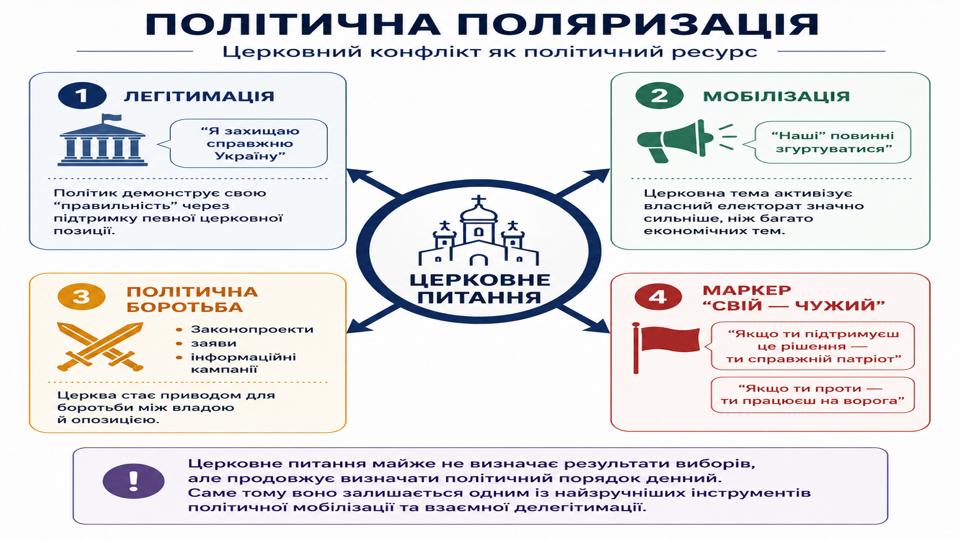
How does the church conflict reinforce this polarization? In Ukraine, almost from the very beginning of independence, politicians have used the church issue as a resource for legitimization. Support for one Orthodox jurisdiction or another made it possible to demonstrate one’s own position regarding Ukrainian statehood, historical memory, or geopolitical choice.
After the beginning of the full-scale war, the church conflict acquired yet another dimension – that of security. The issue was no longer framed only in terms of history or canonical status, but also in terms of potential risks to national security. Under such circumstances, any decision concerning the activities of the Ukrainian Orthodox Church automatically extended far beyond church matters.
Why does this reinforce polarization? A good example was the law prohibiting the activities of religious organizations affiliated with the Russian Orthodox Church. Formally, its purpose was to minimize security risks under wartime conditions. However, the public and parliamentary debate showed that the church issue had simultaneously become an instrument of political confrontation.
For some, supporting the law was a way to demonstrate determination in defending the state. For others, it was an opportunity to call into question the consistency of the authorities or to accuse them of either insufficient or, conversely, excessive severity.
As a result, the church issue ceases to be merely a matter of religious policy. It becomes a marker of political loyalty: one’s position on the church issue is increasingly perceived as an answer to the question: “To what extent are you one of us from the state’s point of view?”
That is why any discussion about Orthodoxy risks very quickly turning into a discussion about the authorities, the opposition, patriotism, and national security. This makes it even more difficult to find solutions that would be acceptable not only politically but also socially.
The paradox is that today the church issue has almost no independent electoral weight. Most voters do not choose politicians on the basis of their religious views. Yet precisely because of its high symbolic sensitivity, the church conflict remains a convenient instrument of political mobilization and mutual pressure between political forces.
This is one of the paradoxes of Ukrainian politics: the Church no longer determines elections, but it can still determine the political agenda. That is exactly what makes it such a convenient catalyst for polarization.
5. Linguistic and Cultural Polarization
After 2022, questions of language, symbols, historical memory, and cultural heritage became some of the principal markers of Ukrainian identity. For many Ukrainians, they ceased to be merely matters of tradition or personal choice and came to be perceived as matters of state resilience and national security.
How does the church conflict reinforce this polarization? The distinctive feature of the Church is that it not only proclaims the faith but also preserves cultural memory. That is why almost every ecclesiastical decision acquires a broader cultural significance.
For example, the Day of Ukrainian Statehood is celebrated on the same day as the Baptism of Rus’. When the Orthodox Church of Ukraine adopted the Revised Julian Calendar, the state likewise moved this holiday from 28 July to 15 July. Formally, this concerns the calendar; in reality, however, it reflects a reinterpretation of the historical narrative and the symbols of Ukrainian statehood.
The same applies to the language of worship. At first glance, this would appear to be an internal matter for a church community. Yet in wartime it is perceived as reflecting a much broader public debate about the place of the Ukrainian and Russian languages in the public sphere.
Why does this reinforce polarization? As a result, the church conflict makes cultural differences morally significant. The debate is no longer merely about which language should be used in prayer or according to which calendar feasts should be celebrated; it is about what kind of cultural model of Ukraine we support.
That is why issues which, under other circumstances, might have remained internal ecclesiastical matters acquire considerable public resonance. The church conflict becomes a kind of mirror of the linguistic and cultural polarization of Ukrainian society while simultaneously reinforcing it by giving cultural symbols an additional, sacred significance.
6. Polarization of Models of the State (What Kind of Ukraine Are We Building?)
If we look carefully at all the previous forms of polarization, we can see that they gradually converge on one fundamental question. We are no longer arguing merely about the Church. We are arguing about what the Ukrainian state and society should look like after the war.
How does the church conflict reinforce this polarization? Within the church conflict, two different logics frequently collide. The first is the logic of the patrimonial state – a state in which influence is determined by proximity to centers of power, the presence of patrons, access to resources, historical privileges, and the ability to defend the interests of one’s own group. Within such a model, church communities naturally seek political allies capable of protecting their positions.
The second is the logic of an open society. Here, the principal values are not connections with those in power but trust between people, equality before common rules, and the ability to negotiate and cooperate despite differences. Within this model, the Church may also be influential, but not through political lobbying. Rather, its influence stems from public moral authority.
Why does this reinforce polarization? Because behind the church debates lies a much deeper question: How do we envision the future of Ukraine? Will it be a society in which every group fights for a special status and guarantees through its proximity to power? Or will it be a society in which different groups learn to cooperate on the basis of common rules and mutual trust?
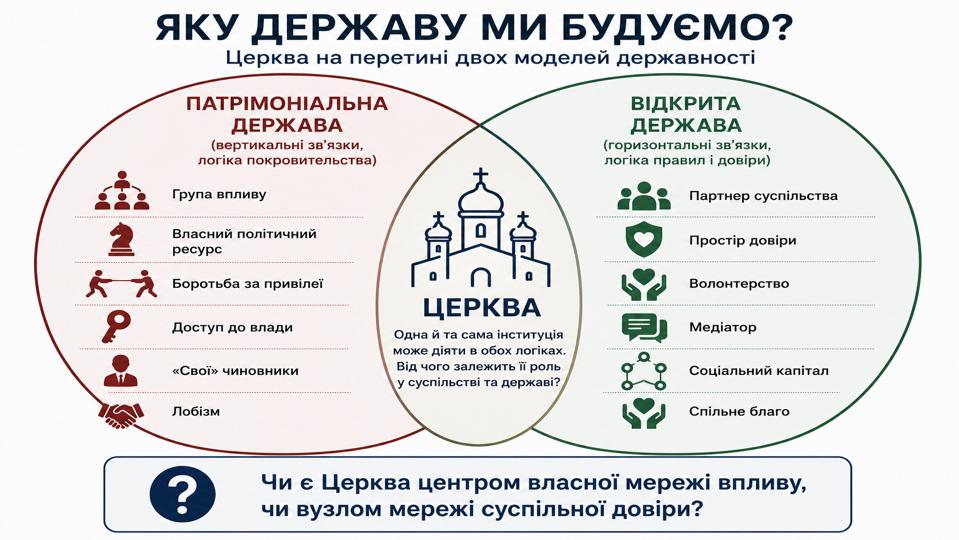
Why is this so important? Because here we arrive at the concept of the common good. The common good is not a situation in which everyone agrees with one another. It is a situation in which even people with different views are able to trust the rules, the institutions, and one another sufficiently to build a common future together.
Block 3. Social Trust as the Foundation for Building the Common Good
If we examine all these forms of polarization carefully, we can notice one common characteristic. They differ in substance – they concern war, politics, language, the Church, or the diaspora. Yet they always destroy the same thing: social trust. Trust is the invisible resource that enables different people to remain one society even when they disagree with one another.
We often speak about trust as though it were simply a moral virtue. We say that it would be good if people trusted one another more. The humanities, however, approach trust in an entirely different way. For them, trust is neither an emotion nor a virtue. It is a social technology. It is a mechanism without which a modern state simply cannot function properly.
When trust declines, a country does not merely become more quarrelsome. It becomes more expensive, slower, and less efficient.
So let us spend a few minutes on the theory of how trust affects the functioning of society.
1. Niklas Luhmann: Trust Saves Society’s Resources
We cannot verify every person, every document, and every decision every single day. Society therefore functions because of trust. Trust enables us to act even when we do not know everything about another person.
When trust disappears, it is replaced by inspections, control, bureaucracy, and suspicion. Society begins to spend enormous resources simply trying to ensure that it is not being deceived.
Key idea: Trust reduces the “cost” of social life.
2. Robert Putnam
There are two kinds of trust.
- We naturally trust “our own” – our family, friends, our community, or our Church. This is called particularized trust.
- But a strong society emerges when people are able to trust not only those who belong to their own circle but also strangers and public institutions. This is what Putnam calls generalized trust.
His key idea: If we trust only our own group, society fragments into separate “bubbles.” The capacity to unite for common goals disappears, even when those goals benefit everyone.
3. Francis Fukuyama
Trust is an economic resource
The economy functions more efficiently where people trust one another. It is easier there to establish businesses, make investments, conclude long-term agreements, and develop entrepreneurship.
When trust is lacking, everything becomes more expensive: more contracts, more inspections, more court cases, and greater risks.
Key idea: Low trust makes a country poorer.
4. Max Weber
The state also survives because of trust
A state cannot exist solely through force or punishment. People must voluntarily recognize its rules, decisions, and institutions as legitimate.
When trust in institutions is undermined, people become increasingly unwilling to cooperate with the state, even if its laws formally remain in force.
Key idea: Without trust, there is no genuine legitimacy of the state.
To summarize briefly:
- Luhmann: Trust makes society simpler.
- Putnam: Trust enables cooperation with strangers.
- Fukuyama: Trust strengthens the economy.
- Weber: Trust gives the state legitimacy.
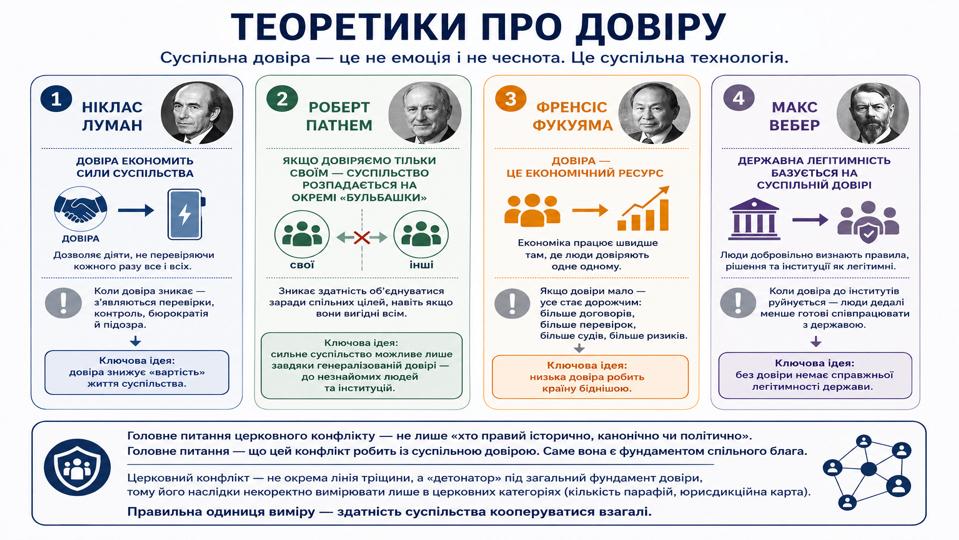
Therefore, the central question of the church conflict is not merely: “Who is historically, canonically, or politically right?” The central question is: What is this conflict doing to social trust? It is social trust that forms the foundation of the common good.
The church conflict is not simply another line of fracture. It is a detonator beneath the common foundation of trust. For that reason, its consequences cannot properly be measured solely in ecclesiastical terms – such as the number of parishes or a map of ecclesiastical jurisdictions. The proper unit of measurement is society’s overall capacity for cooperation.
And finally, let me leave you with a difficult question:
What is more dangerous for a country: living without the whole truth, or living without trust? Are we prepared to sacrifice unity for the sake of complete justice? Or justice for the sake of unity?