

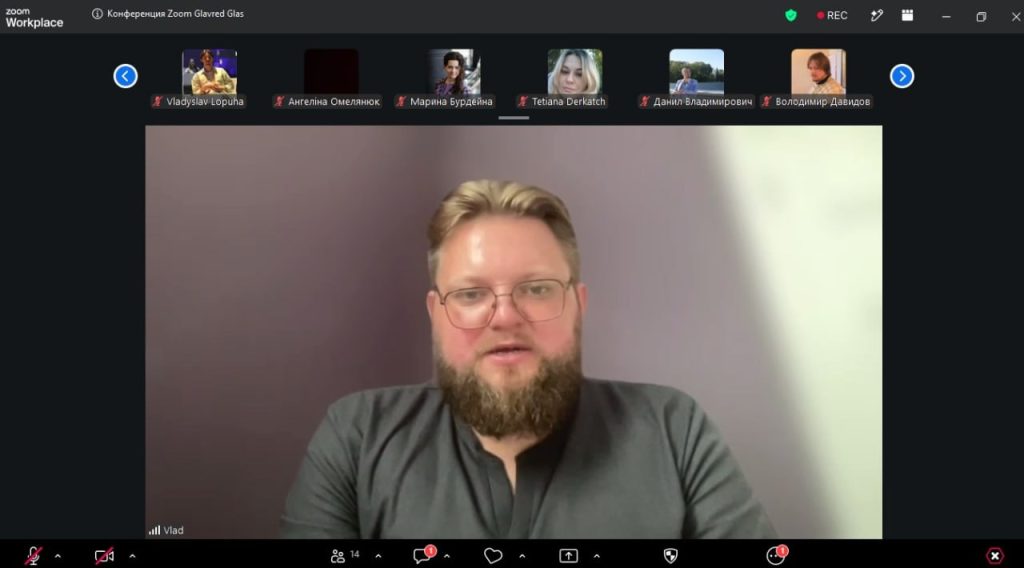
“Coping with Collective Trauma: Russian War Crimes Against Children. Ways of Countering Them and Rehabilitation. How Can Society Help Restore and Protect Childhood in Ukraine?” – this was the topic of the latest webinar devoted to one of the most painful consequences of Russian aggression.
The speaker at the webinar was researcher and investigator Vladyslav Havrylov, who works on issues related to the forced transfer and deportation of Ukrainian children. His presentation made it possible to look at the problem more broadly than simply through statistics on abducted or forcibly removed children. The discussion focused on a system in which the transfer of a child may be only the first stage of a much larger process – depriving the child of ties with their family, Ukrainian identity, language, and culture, and ultimately turning them into part of Russian society.
From “Evacuation” to the Erasure of Identity
One of the key points of the webinar was that the Russian side attempts to present the removal of Ukrainian children as evacuation from combat zones.
However, according to Vladyslav Havrylov, the very mechanics of this process indicate otherwise.
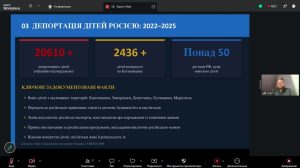
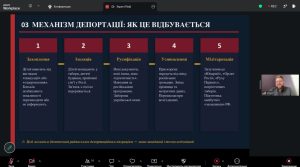
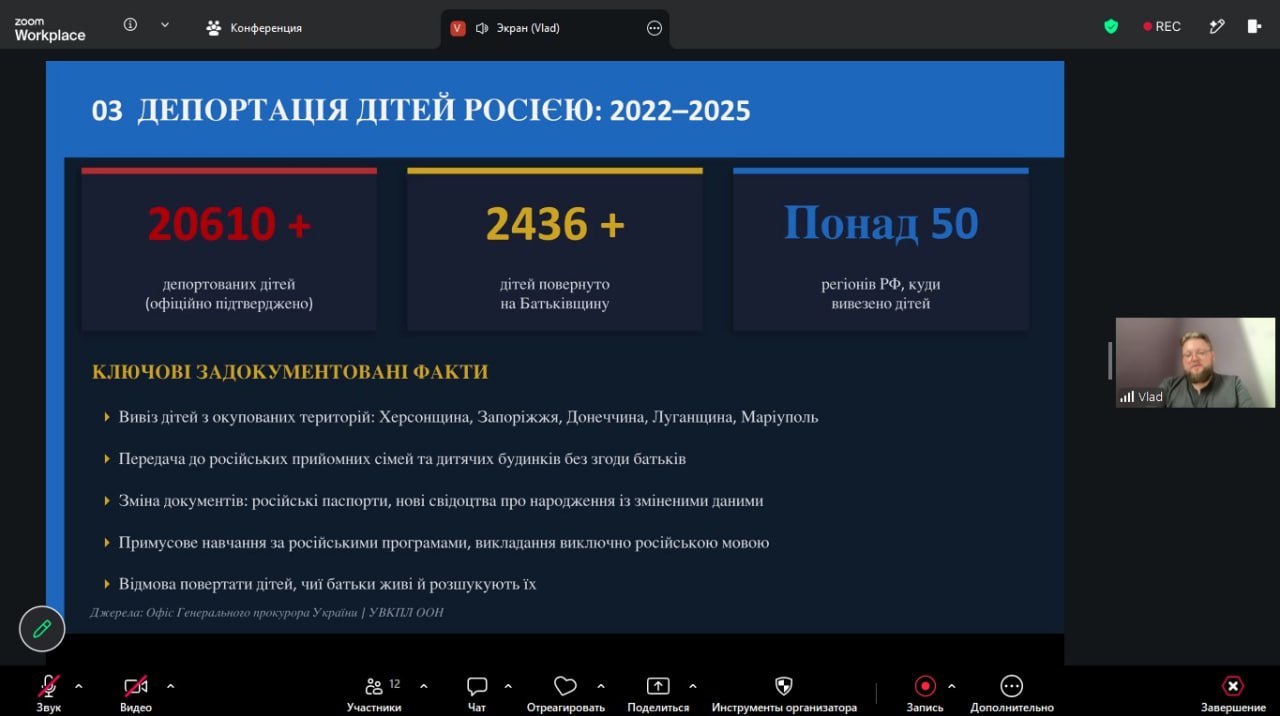
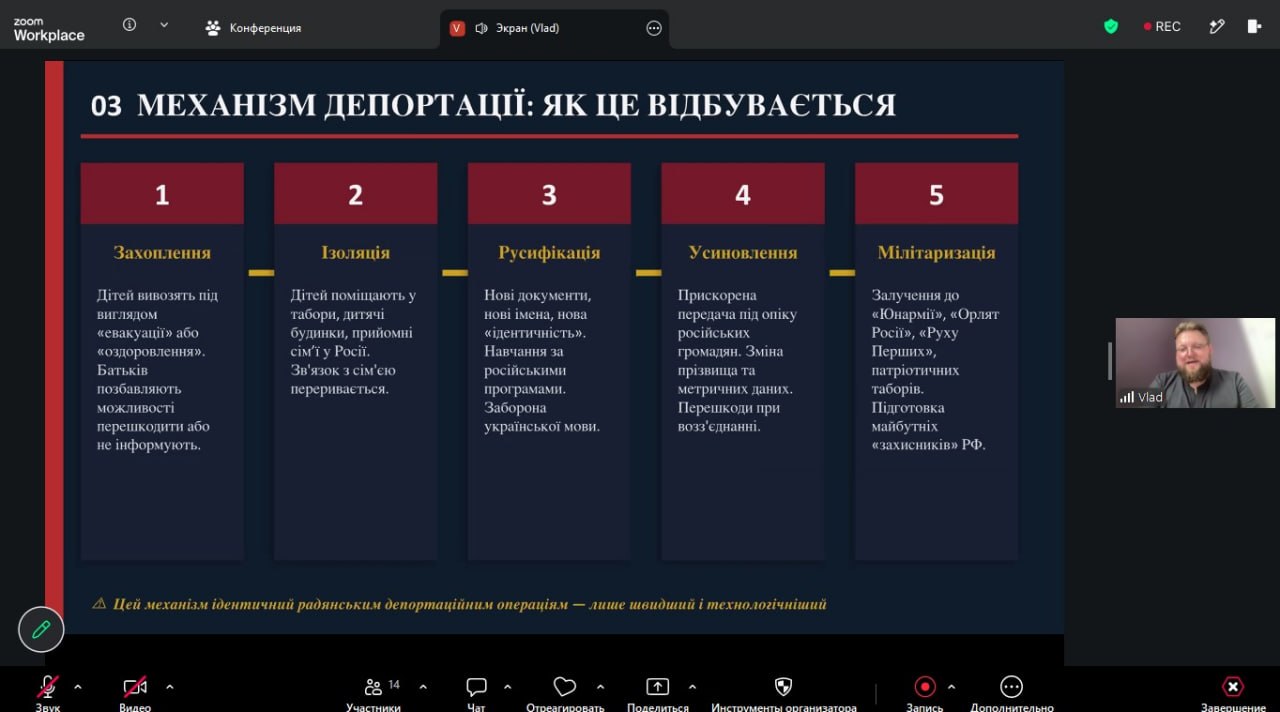
Children from occupied territories are initially taken away, supposedly to summer camps. Parents are often told that this is necessary for temporary recreation or for safety reasons. But afterwards, the children may not be returned. They are transferred to different regions of Russia, thousands of kilometres away from Ukraine.
According to the speaker, the geography of such transfers already encompasses more than 50 Russian regions, and the number of such locations continues to grow. Ukrainian children have been found not only in the Rostov, Belgorod, and Voronezh regions, but also in Tatarstan, Siberia, and the Russian Far East. Cases have also been documented of children being held in camps in North Korea.
Particularly dangerous is the subsequent change in the child’s legal status. Ukrainian documents may be taken away, biometric data collected, photographs taken, and Russian documents subsequently issued. In some cases, children’s first and last names are changed.
This creates an additional barrier to locating them.
But the problem goes even deeper. The child is transferred into the Russian education system, where the Ukrainian language, history, and cultural memory are displaced. In this way, physical relocation becomes a process of gradual separation from the child’s previous life.
Not Just Deportation, but an Attempt to Create a “New” Person
One of the most revealing examples discussed during the webinar was the story of a boy from Mariupol named Filip, who was adopted by Russia’s Commissioner for Children’s Rights, Maria Lvova-Belova.
According to the speaker, the Russian side itself effectively demonstrated publicly how difficult the process of his “re-education” was: the boy retained pro-Ukrainian views, did not want to accept the Russian education system, and resisted the environment imposed upon him.
This story demonstrates a fundamental point: a child is not a “blank slate” who can simply be transported to another country and automatically made part of another society.
This is precisely why Russia needs more than territory, documents, or physical isolation. It needs time.
Time during which the child stops speaking Ukrainian, loses contact with their family, studies according to the Russian curriculum, receives Russian documents, becomes accustomed to a new environment, and then gradually begins to perceive the imposed identity as their own.
From Russification to Militarization
The next stage discussed by Vladyslav Havrylov is militarization.
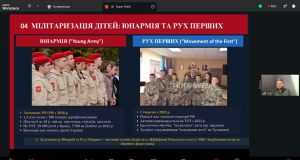
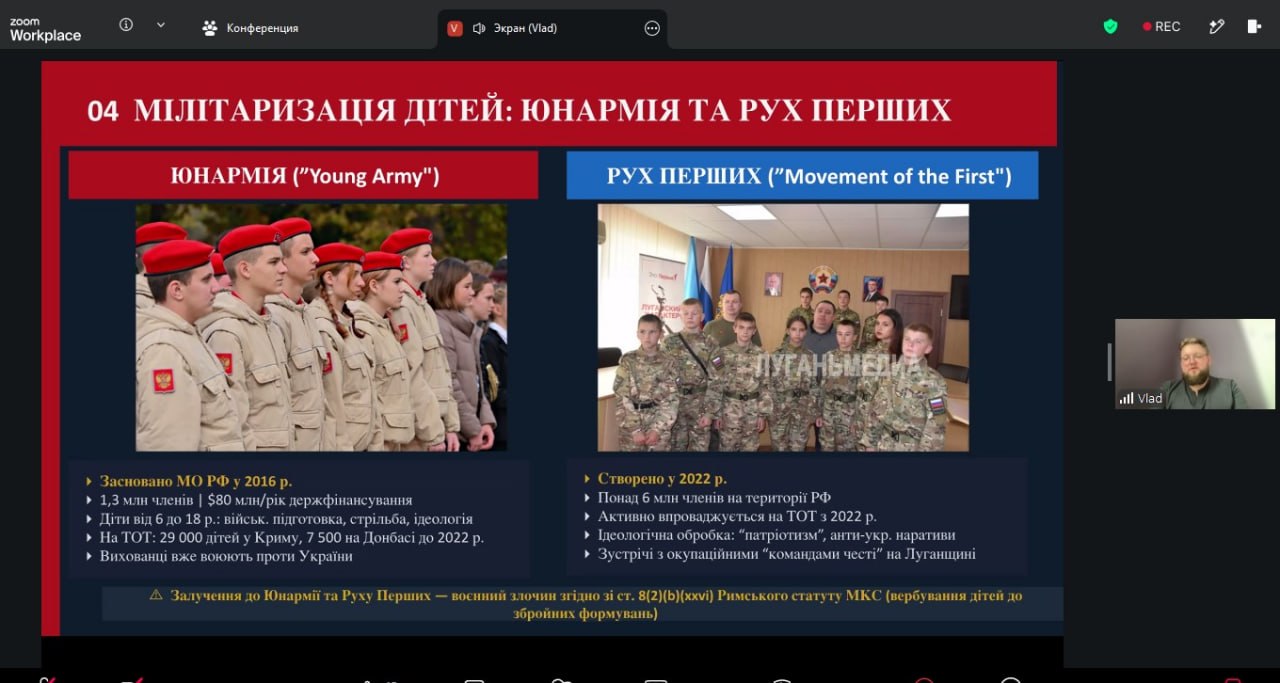
Large-scale youth organizations operate in the occupied territories and in Russia, including Yunarmiya and the Movement of the First. According to the speaker, their presence is expanding ever more widely, with branches opening even in small settlements.
Children and adolescents are involved in military-patriotic activities, taught how to handle weapons, given military training, and encouraged to develop a corresponding worldview.
As a result, childhood is gradually transformed into preparation for future participation in the Russian state and military system.
And here the question of time becomes particularly acute.
If today we are talking about a child who needs to be brought back, in five or ten years this may already be a young person who has not only lost their connection with Ukraine but has become part of Russian society and even the Russian military.
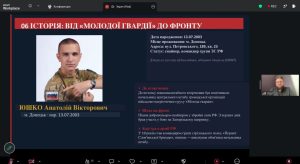
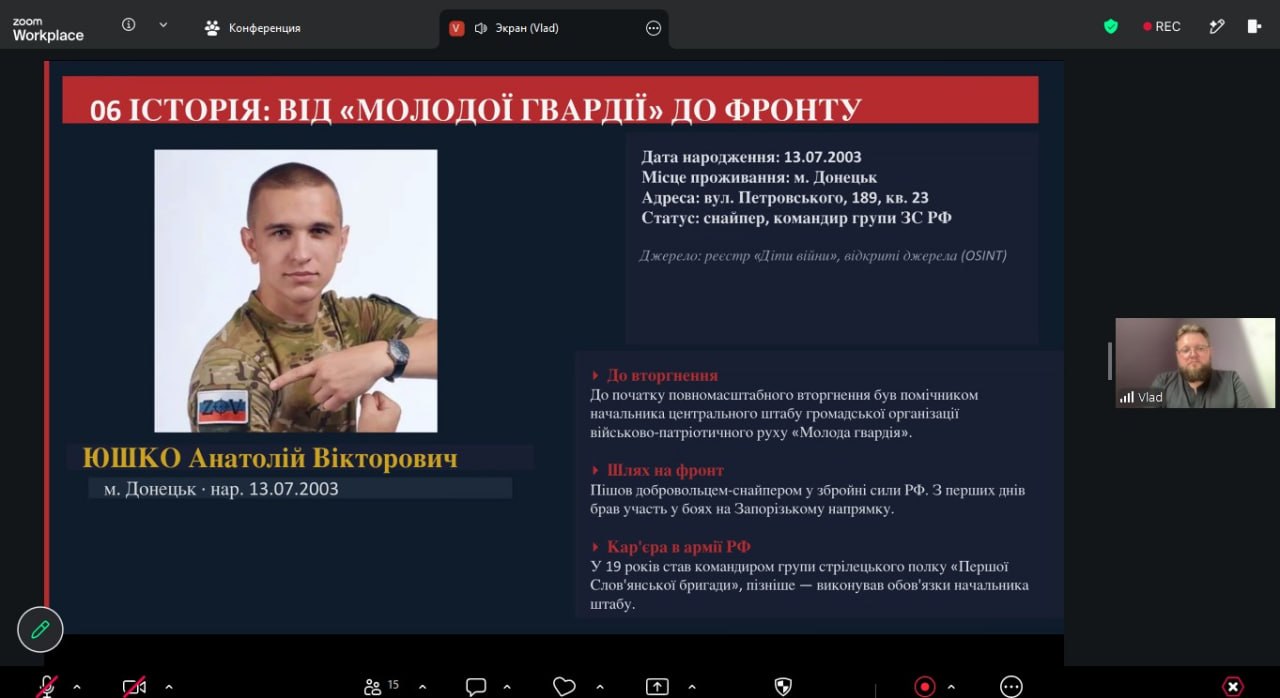
During the webinar, examples were given of young people from occupied territories who were initially identified as Ukrainian children who had been forcibly removed and who later found themselves within the Russian military system.
This is one of the most alarming prospects: Russians may attempt to transform abducted Ukrainian children from victims of the war into its participants.
A History That Recalls the Darkest Practices of the Twentieth Century
A separate dimension of the discussion concerned historical parallels.
During the Second World War, Nazi Germany practised the abduction of children from occupied territories who were considered suitable for Germanization. Their names and documents were changed, they were deprived of their previous cultural environment, and attempts were made to integrate them into German society.
Vladyslav Havrylov drew attention to the similarity between certain mechanisms and contemporary Russian practices. At the same time, according to him, the current scale and systematic nature of Russian policy create an extremely complex precedent for international law. Russia calls its actions “evacuation.” But evacuation should not mean that a child disappears from the view of their state, has their documents taken away, has ties with their parents severed, has their identity changed, is transferred to another family, and is kept for years in foreign territory.
That is why the return of children is not merely a humanitarian issue. It is a matter of international law, accountability, and the protection of a person’s very identity.
The Russian System Does Not Operate Alone
Another important point of the webinar concerned the scale of involvement of Russian state and social infrastructure.
This includes governors, officials, occupation administrations, security agencies, and paramilitary organizations. The speaker also specifically addressed the involvement of the Russian Orthodox Church.
What we are dealing with, therefore, is not a series of random episodes in which individual people violate the law.
It is a system in which different institutions perform different functions: some organize transfers, others receive children, others provide education, still others engage in ideological indoctrination, and yet others carry out militarization.
That is why the question of accountability must concern not only the direct perpetrators but also those who create, coordinate, and ensure the functioning of this system.
Bringing a Child Back Is Not Enough
However, the webinar was not only about Russia’s crimes.
Its second part was devoted to a much more difficult question: what should Ukraine and Ukrainian society do after the children return?
A child who has experienced occupation, evacuation, deportation, the loss of parents, or prolonged life in a Russian environment does not return in the same condition they were in before the war. Therefore, return must mean more than physical movement across the border. The child needs to regain a sense of safety, belonging, and trust, as well as the opportunity to build a future. And this is precisely where the role of youth organizations becomes exceptionally important.
From a Rehabilitation Centre to a Normal Life
During the practical part of the webinar, participants were invited not merely to discuss the problems but to develop concrete steps and roadmaps that society could implement.
One important idea was to reject an approach in which a child remains permanently defined as a “victim.”
Participants in one of the groups emphasized that support for children and adolescents evacuated from frontline areas should not be limited to specialized rehabilitation programmes.
A child needs an ordinary life. Camps, sports, tourism, summer schools, creative and educational projects, forums, new friends, and teamwork – all of these can be part of recovery. Sometimes it is shared activity, rather than constant discussion of trauma, that restores a child’s sense of normality. It is important not to assign them the role of a “victimized child” for years.
The purpose of rehabilitation is not to remind a person of their trauma but gradually to restore their ability to live beyond it.
What Should Be Done for Children Who Have Returned from Occupation?
Webinar participants worked on four major areas.
The first was the rehabilitation of younger children and adolescents evacuated from frontline territories. Here, the emphasis was placed on socialization, non-formal education, sports, culture, and joint projects.
The second was the integration of children removed from temporarily occupied territories. This is a more difficult task, since some of these children may have spent years in the Russian information and education environment.
The third was preparing adolescents for the next stage of their lives: entering university, adapting to the student environment, finding their first job, and making professional choices.
And the fourth concerned young veterans and military personnel released from captivity.
A Veteran Is More Than a Veteran
Participants also worked separately on the question of how to involve young veterans in Ukrainian society.
The key idea here was agency. A veteran should not remain a person to whom society constantly says, “We will help you.” It is far more important to ask, “What can we create together?”
Sports, culture, media, volunteering, entrepreneurship, and education – shared activities can create horizontal ties between veterans and civilian youth. In such a model, a veteran becomes not an object of social assistance but a partner, mentor, organizer, and creator of their own projects. This is a fundamentally important change in perspective.
A Separate Category: Those Released from Captivity
Military personnel returning from Russian captivity require a different approach. After prolonged violence and isolation, one cannot expect a person to immediately become involved in active social life.
The first stage is safety, medical care, psychological support, restoration of documents, resolution of housing and social issues, and work with the family.
Only after stabilization can a gradual return to youth communities, education, work, and civic life begin. At the same time, a person should not be forced to remain permanently in the role of a “former prisoner of war.”
They need to regain not only their physical freedom but also the right to have an ordinary future.
Restoring Childhood Is a Shared Responsibility
One of the main conclusions of the webinar is that Ukraine does not yet have a sufficiently large-scale and comprehensive strategy for addressing the consequences of this trauma. After returning, children, adolescents, young veterans, and those released from captivity are often left alone with problems that the state is not always able to resolve promptly: housing, education, social adaptation, psychological support, employment, and return to normal social life. State policy must therefore become much more systematic, while support programmes must be broader in scale, long-term, and interconnected. At the same time, even the state cannot cope on its own with the challenge of collective trauma on such a scale. An entire ecosystem is needed in which the state, civil society and youth organizations, educational institutions, businesses, and society itself work together to create conditions for a person to return not only home but also to a full life.
The state must provide policies, funding, medical and psychological assistance, education, and legal protection. Civil society organizations can create environments of trust and socialization. Youth organizations can open spaces for horizontal connections for children and young people. Schools and universities can help them return to education and professional life. Businesses can create opportunities for first jobs, internships, and professional self-realization.
And society as a whole must learn to see these people as more than victims of war. A child who has survived occupation is not forever “a child from the occupation.” A veteran is more than a veteran. A person released from captivity is more than a former prisoner. These are people who have the right to a life that is not defined solely by what the war has done to them.
Restoring the Ability to Determine Their Own Future
The Russian policy towards Ukrainian children described by Vladyslav Havrylov is aimed at precisely the opposite: depriving a person of the ability to determine for themselves who they are.
Change their documents. Cut them off from their family. Change their language and education. Rewrite history. Shape a different identity. And then determine their future. Ukraine’s response must be the opposite.
To bring a child back means restoring more than their home. It means restoring their right to their own memory, their own dignity, their own identity, their own choices, and their own future.
That is why the struggle for Ukrainian children does not end the moment they cross the border on their return.
It will end only when a child can once again feel: my life belongs to me.
And this may become society’s strongest response to Russia’s attempt to take away the future of Ukrainian children.